diaries
What Does It Mean to be an Artist in Iran Right Now?
April 2026
7 min read
Guest Writer: Sophie Howe
What more can the arts ecosystem provide for artists working in war zones? How can publications offer a spotlight to artists whose identities must remain hidden? Ruminating on these questions, Sophie Howe connects with Affsoongar, a visual artist from Tehran, in brief moments of internet access despite the digital blackout in Iran.
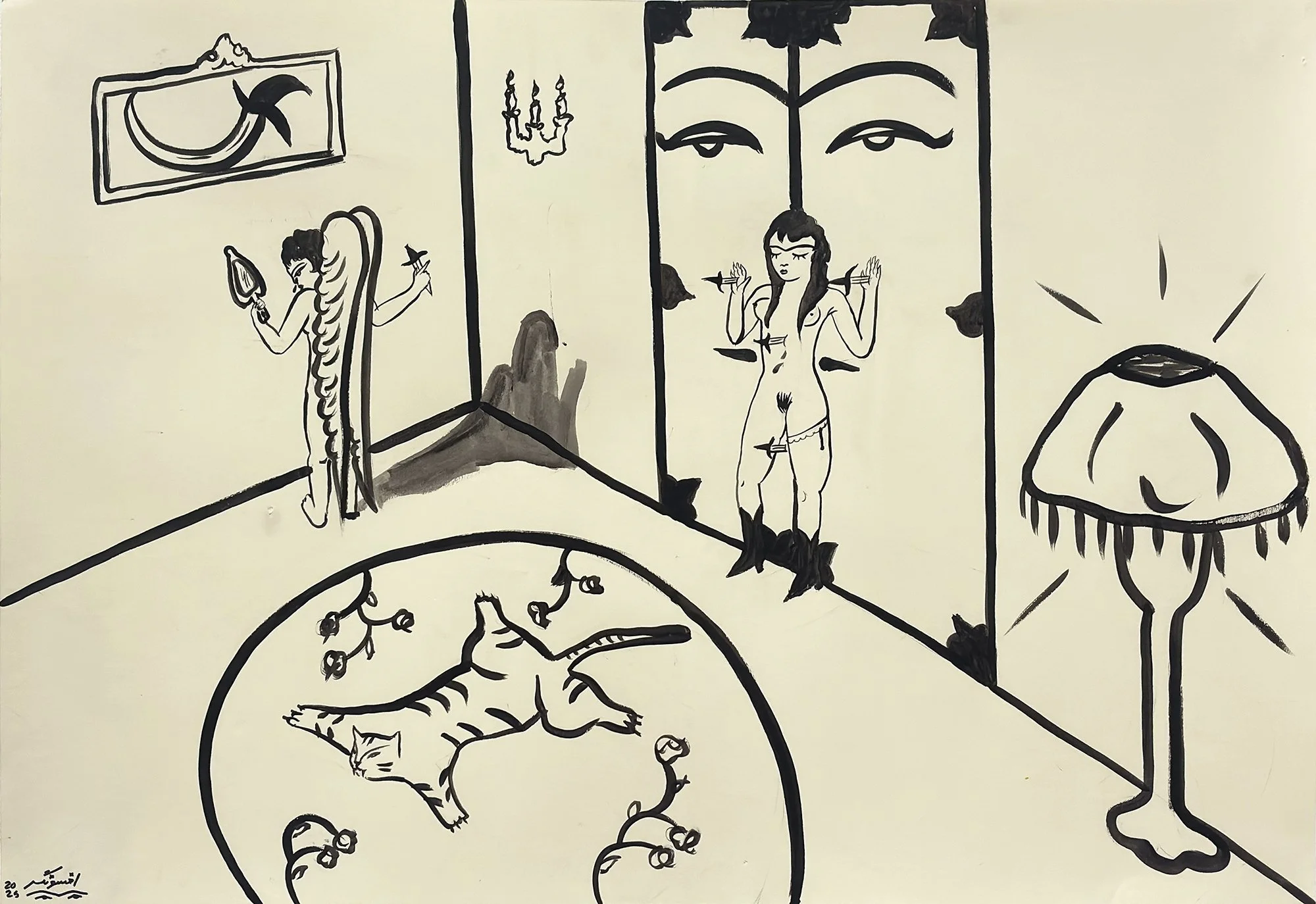
Queer femme fatales, angels, ghosts, and guns recur throughout Affsoongar’s work, conjuring up narratives of surveillance, secrecy, and desire.
Affsoongar, Behest (Heaven), Oil Pastel on Cardboard, 28” X 40”, 2025. Photo courtesy of Dean Brown.
We have maintained a friendship despite never meeting. I don’t know her face beyond pictures of her eyes; her features below the bridge of her nose are always covered by fabric when I see her on social media. I hesitate to describe any part of her with more clarity. As a writer, I must be vague. As a painter, she must be too. I don’t know her real name - but Affsoongar, meaning enchanter in Farsi, is about as apt as a name can be.
Subscribe to our newsletter for more opinion pieces
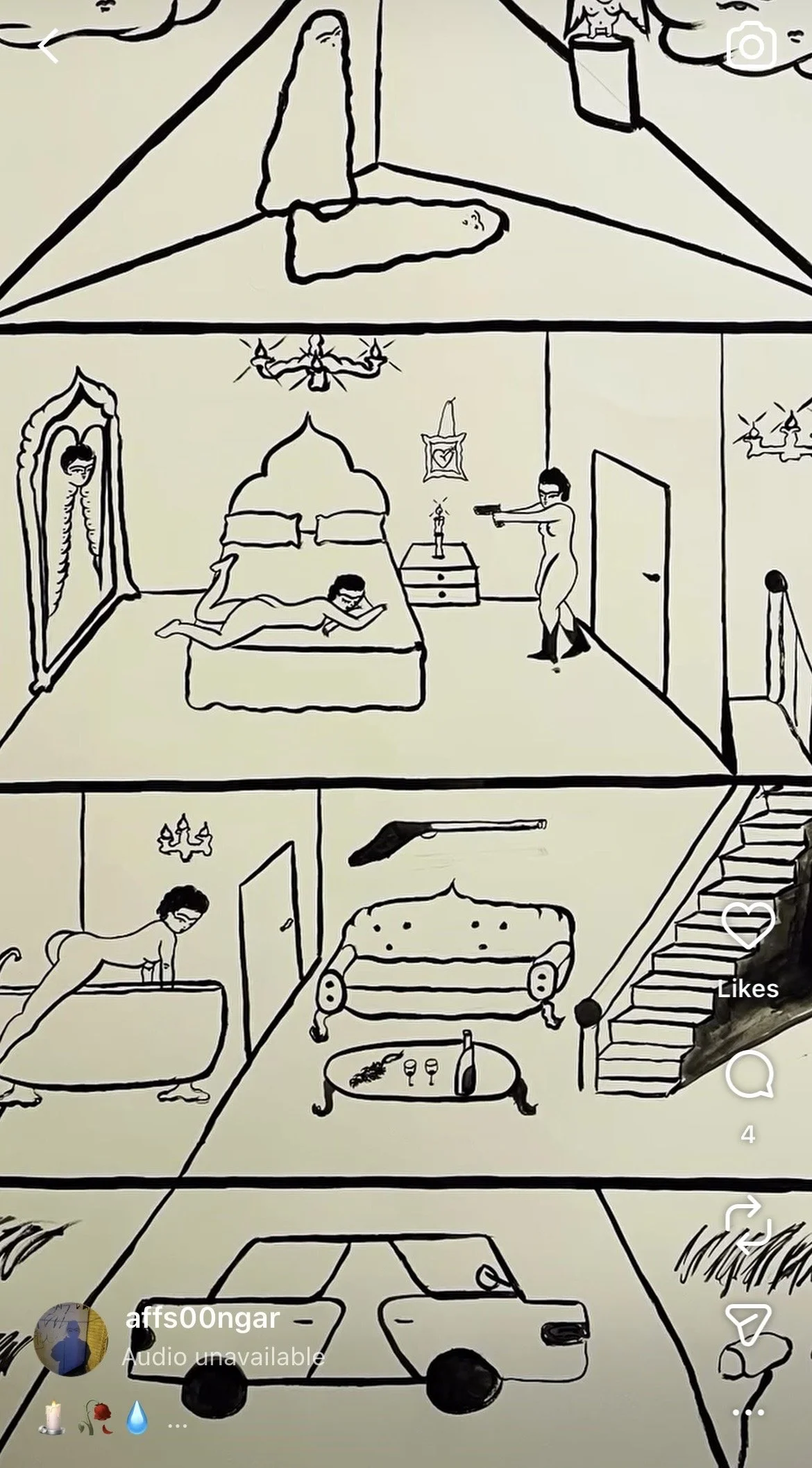
Affsoongar, Mad House.
I’ve only seen her work digitally, something that I don’t believe inhibits my ability to be moved. In a way it is representative of the distance between us: looking at Mad House (2025) through my phone screen, I see angels, among other things. Ghosts and guns inside a haunted house, and an un-moving car, in opposition to the racing cars in her other work. Candelabras are a recurring motif, but never seem to be a true source of light. There is always lingering darkness.
Working my way through the stories of the house, in the attic, two ghosts are represented as hovering sheets. One mounts the other, they peer at each other with surprise expressed through a tilted head and furrowed brow. These are the most self-obsessed ghosts I’ve observed. They don’t seem particularly interested in haunting the living; perhaps the living are doing enough to torture each other. Above the ghosts are glamorous clouds with tiny pouting lips and seductive eyes. Are they protectors or surveyors?
In the bedroom, a naked female figure lays languorously on the bed, foot up in the air, assuming a nonchalance despite the presence of a figure unclothed save for cowboy boots, holding a gun just above the other figure’s head. Maybe the gun is aiming for the angel, hovering in a liminal space beyond the bare butt. The angels seem awkward, uncertain in their role. Nobody seems to want to fully participate as either perpetrator or victim.
On the ground floor, a femme figure crawls into the tub, turning their head as if to make sure someone is watching. Above the empty couch rests a rifle, pointing towards the staircase. Left behind, half-drunk, are two glasses of wine. On the street sits a car, hinting at the potential for escape. A queerness withstands and overshadows even the darkest of suggestions.
As I zoom in on Mad House, I receive an email from Affsoongar:
“Hi Sophie, here we go again, another war, another interview. I am writing to you with a broken heart from the beating heart of my city, Tehran.”
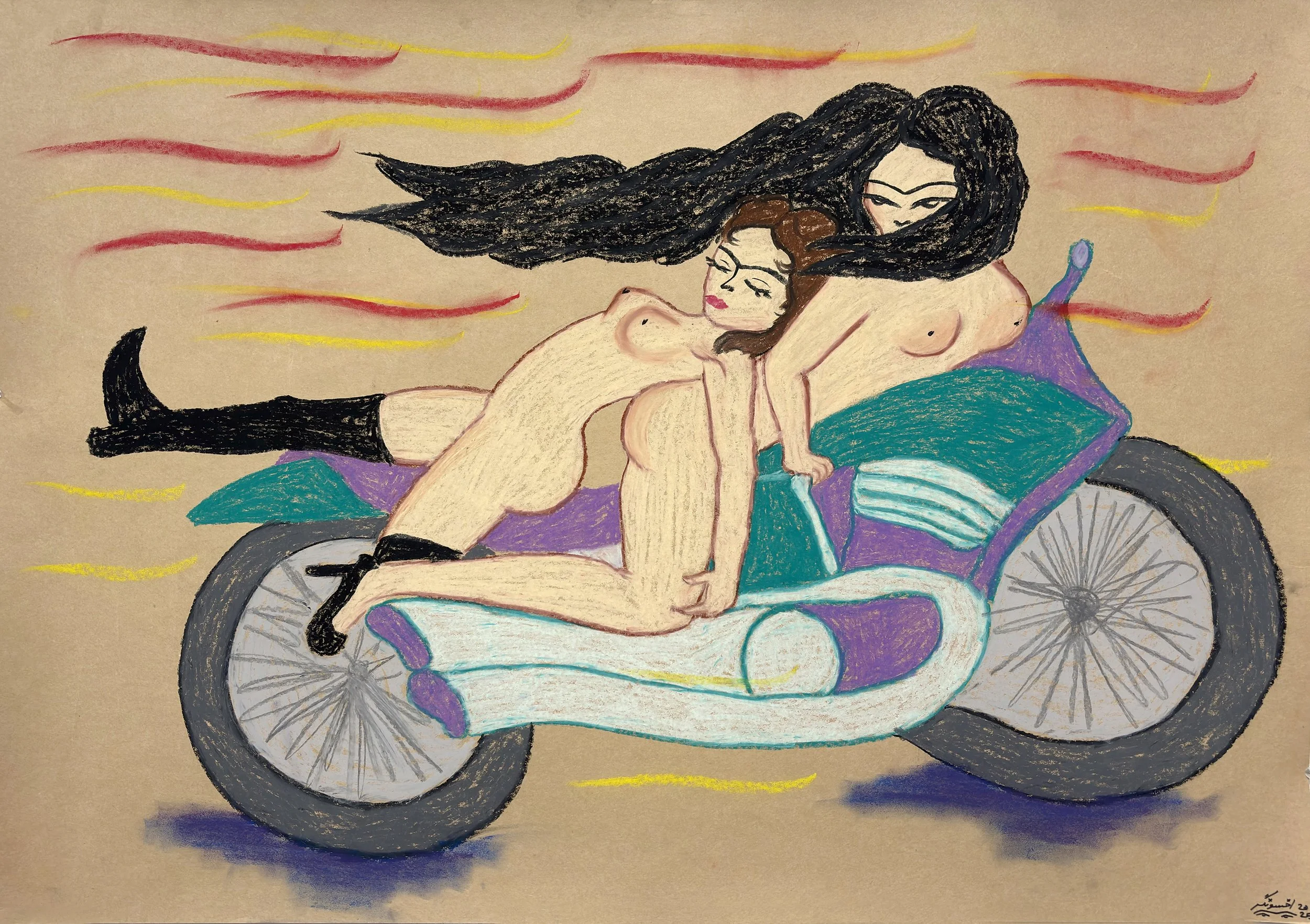
Affsoongar, Predictable, Oil Pastel, Soft Pastel on Cardboard, 28” X 30”, 2025. Photo courtesy of Dean Brown.
Through writing this piece, I have had to relearn what art criticism can be or what art writing has the potential to be. There is a place within the art world to be clinical, technical, and decisive, and sometimes emotion overrides the desire to be didactic. Quite simply, I am afraid for my friend.
Her imagery offers an insight into her daily life and inner world - which right now involves bombings, trips out of the house to buy flowers, hanging out with friends to maintain her sanity, and hoping that everything will get back to normal again. She describes her style as “raw, childish” and I understand what she means. Not childish to imply that her work is unskilled or done with haste, but rather, she creates with the honesty of a child, without fear as an inhibitor.
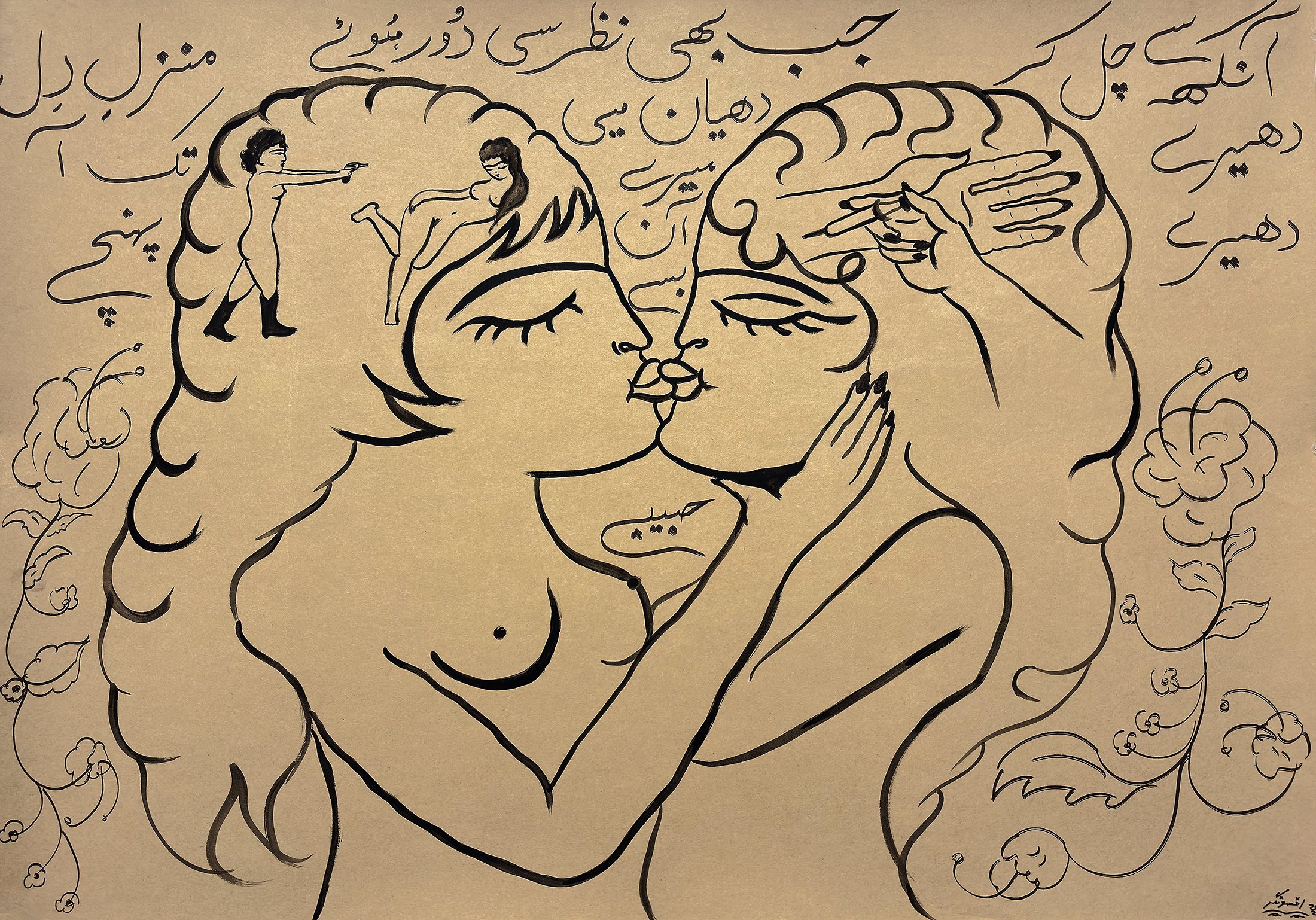
Affsoongar, Dubai Effect, Acrylic on Cardboard, 28” X 40”, 2025. Photo courtesy of Dean Brown.
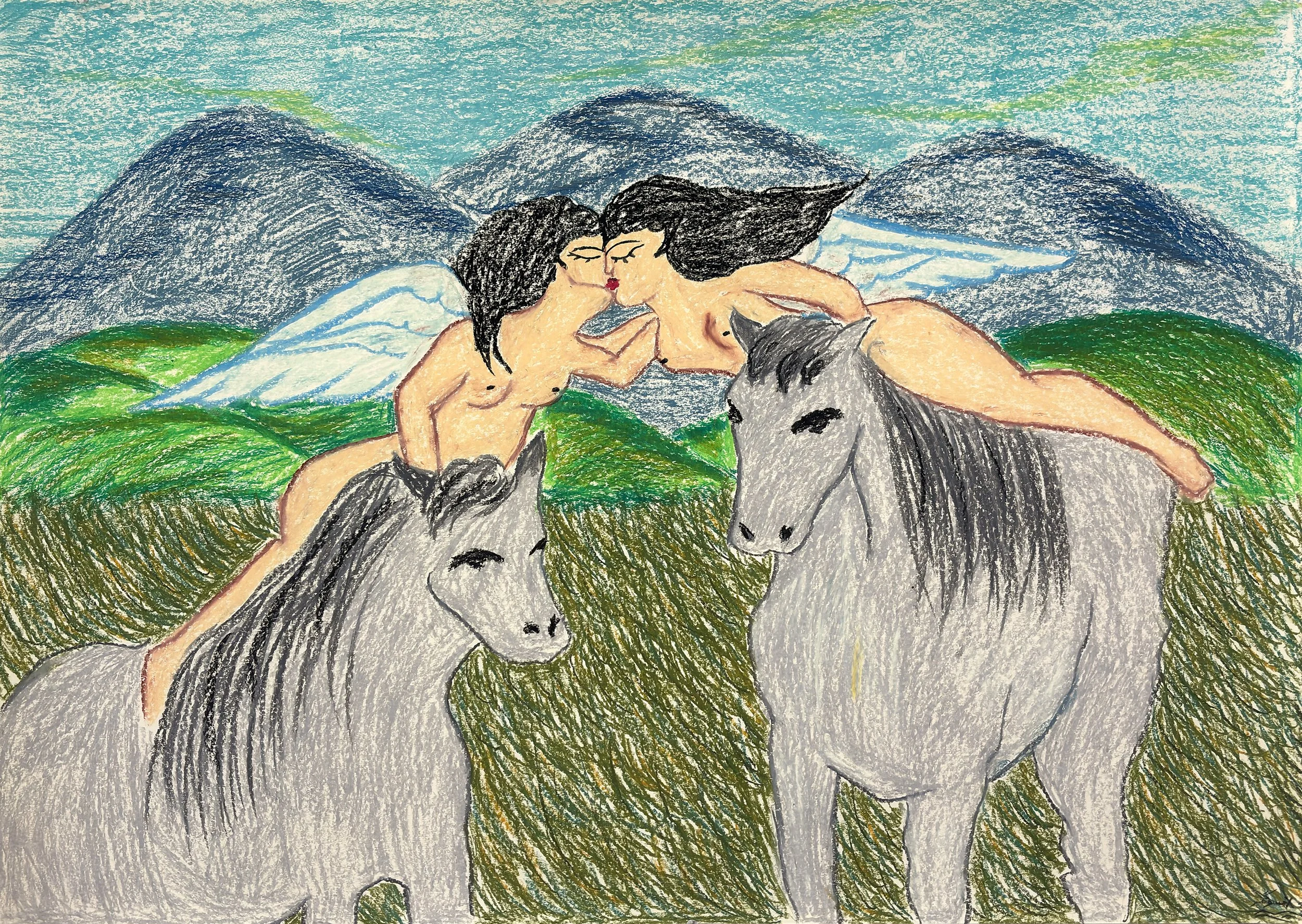
I can’t help but want to draw a narrative throughline between Affsoongar’s visuals. Her figures either reappear, or there are many look-alikes in her universe. In Dubai Effect (2025), nearly identical characters kiss. To differentiate between them, the character on the left holds two more naked figures inside her hair. This might be the same lesbian assassin from Mad House. Swirling around them are flowers and words in Farsi, a nod to the poesia visiva (visual poetry) movement of the 1960s.
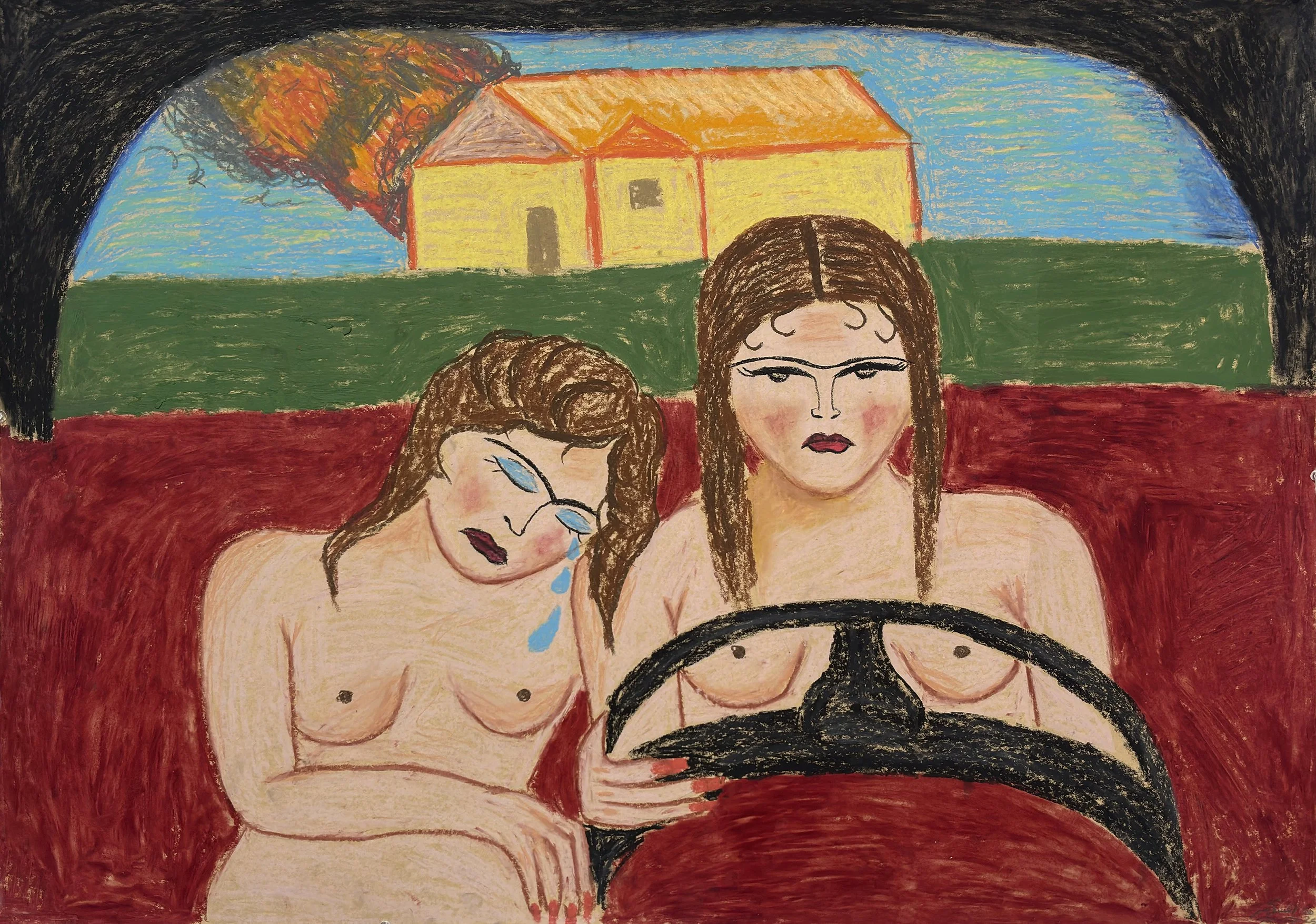
Affsoongar, Fever Dream, Oil Pastel, Oil Stick on Cardboard , 2025. Photo courtesy of Dean Brown.
In Fever Dream (2025), two topless female figures sit in a car, one leans her head on the driver’s bare shoulder and lets her tears stream down to her breast. Behind them, a house burns. Are they ending the torment of the Mad House once and for all, or is this a requiem for a lost and changing homeland?
Her email continues: “My heart beats for my country and my people. I never had the intention of immigrating to another country but in these dark days I am looking for a funded residency that is also visa friendly for Iranians so that I can perhaps get to a safer place to create until things are calmer.”
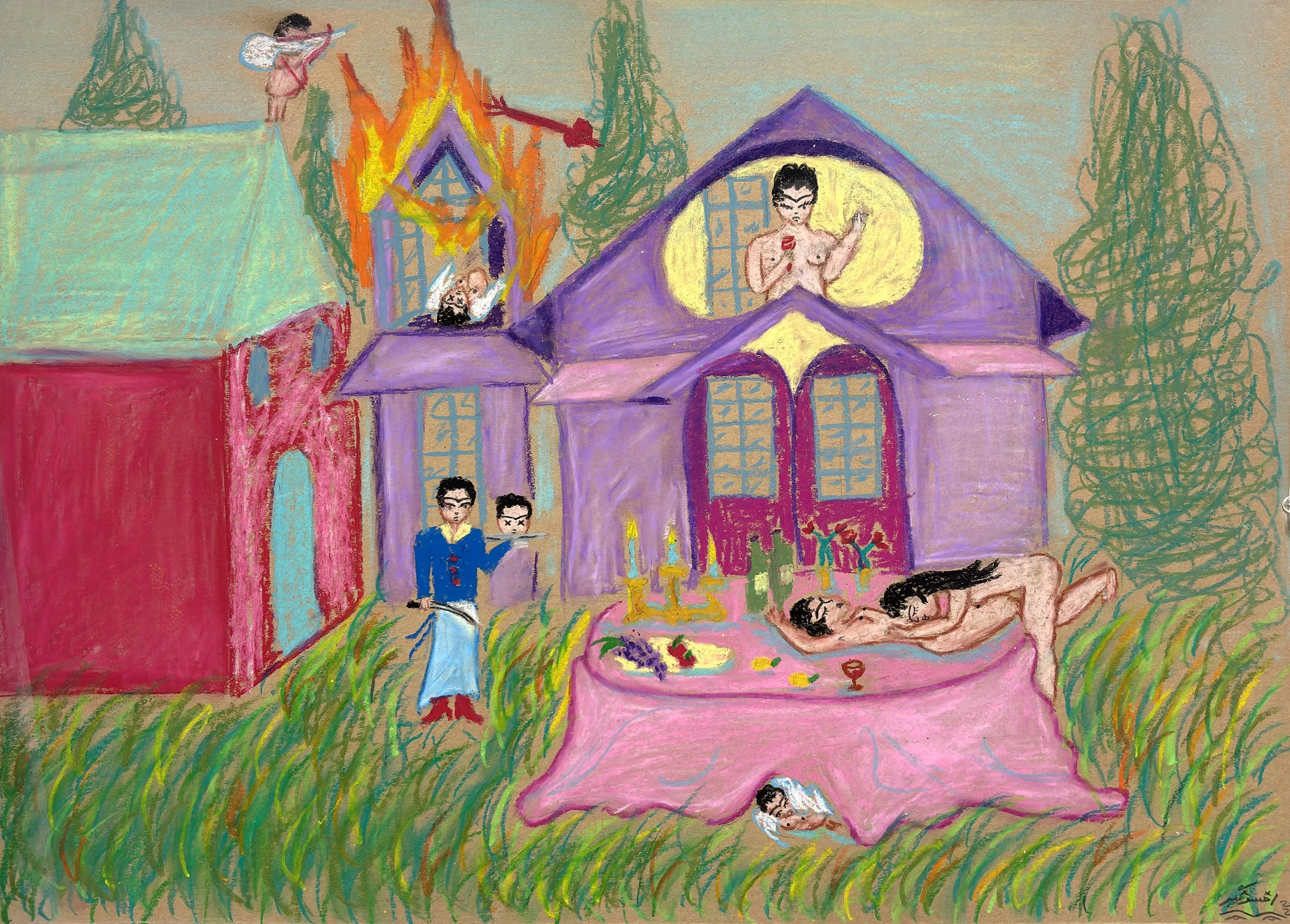
Affsoongar, Hopeless Romantic, Oil Pastel on Cardboard, 20” X 28”, 2025. Photo courtesy of Dean Brown.
Subscribe to our newsletter for more opinion pieces
It is an important but fine line to honor the severity of Affsoongar’s situation without exacerbating it. We know the dire consequences for writing this piece, and yet, she wants to forge ahead. This has led me to wonder: what more we can do within the art world to support artists working in war zones? How can publications offer a spotlight to artists whose identities must remain hidden? The reasons behind her anonymity are clear; she’s an underground artist exploring themes of resistance and queer desire. “My practice is everything against this government. I put my tags on the streets of Tehran in red, which is the color of oppression,” she tells me. Not only would finding a residency for Affsoongar further her career, it could also be life saving. All of this is further complicated by weak internet connection, which limits her ability to find appropriate residencies and complete application forms. She tells me that in Iran, currently, it’s a crime to be online. “I am used to the bombs at this point but I’ll never get used to the digital blackout,” she tells me.
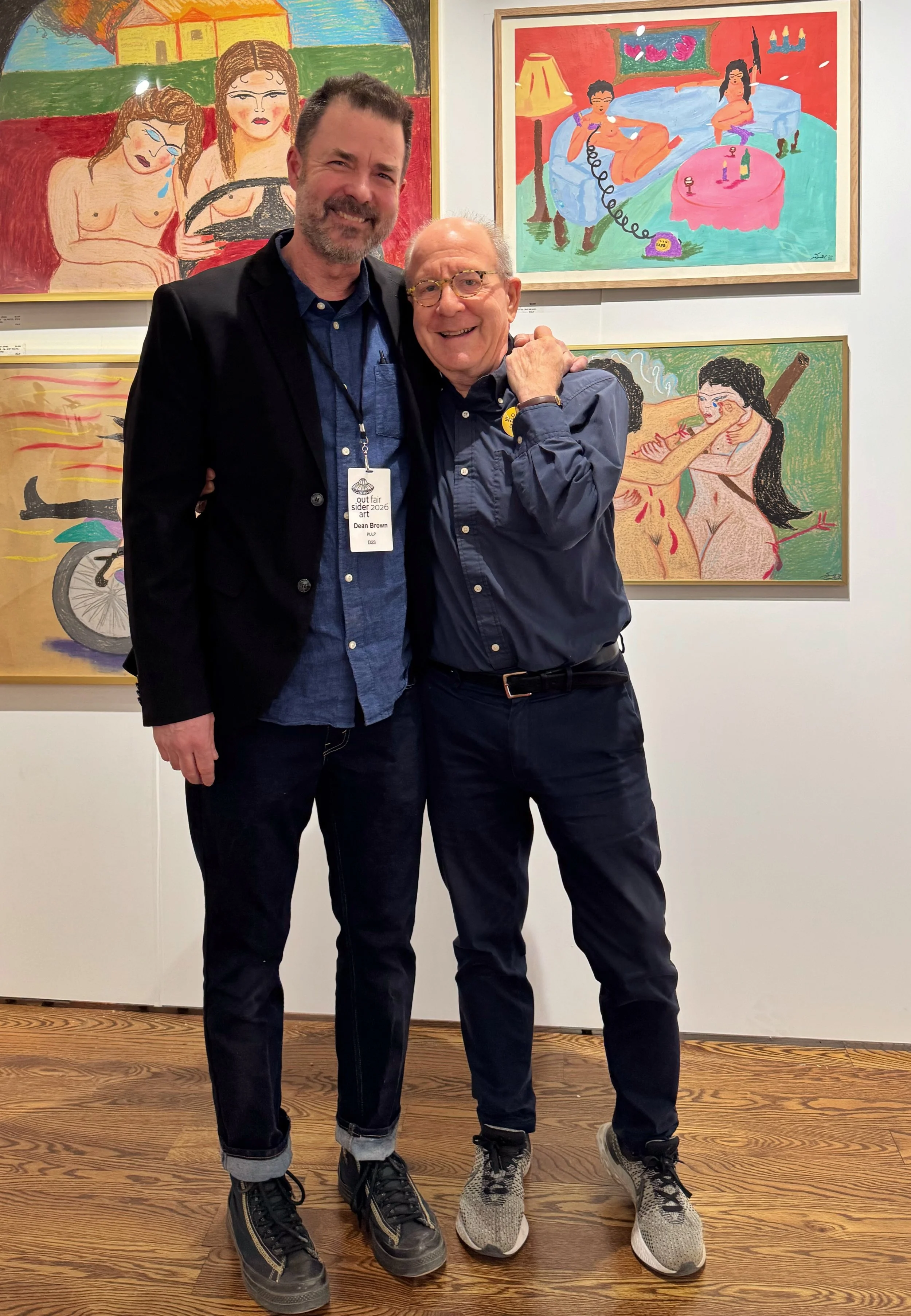
Dean Brown founder of PULP with Jerry Saltz at Outsider Art Fair. Photo courtesy of Dean Brown.
In March of 2026, Affsoongar's drawings were shown at Outsider Art Fair in New York City. She had to smuggle them out of Iran, as she had in the autumn of 2025 for her show at PULP in Holyoke, Massachusetts. Last year, at least she had access to the internet. This year, she smuggled them during a revolution and a digital blackout. Her work is available as digital print files which can be purchased directly through the artist, although she asks for patience as the files can be difficult to send without a strong internet connection. She wonders if she will be able to exhibit her work outside of her country again. Beyond this, she wonders if she will see her country and her people free.
This piece is, in many ways, a call to action. I hope that it results in a network of care to support artists in warzones.
She ends her email:
“At the end of the day all I can say is this power to the people of Iran. Long live resistance. Best regards, Affsoongar”.