diaries
How Should Artists Price Their Works?
March 2026
10 min read
Arts Editor: Victoria Comstock-Kershaw
Contributors:
Eva Dixon
Mingzhang Sun
Manel Margalef
Will Jarvis
Darren Flook
Raymond Salvatore Harmon
What's your artwork actually worth? A 2024 study analysed 34,000 auction sales and found that the visual qualities of an artwork barely influence its price. The honest answer involves your social network, your collectors' net worth, and a behavioural economics concept called the endowment effect. We asked artists, gallerists, and researchers how to approach the ever-difficult task of pricing.
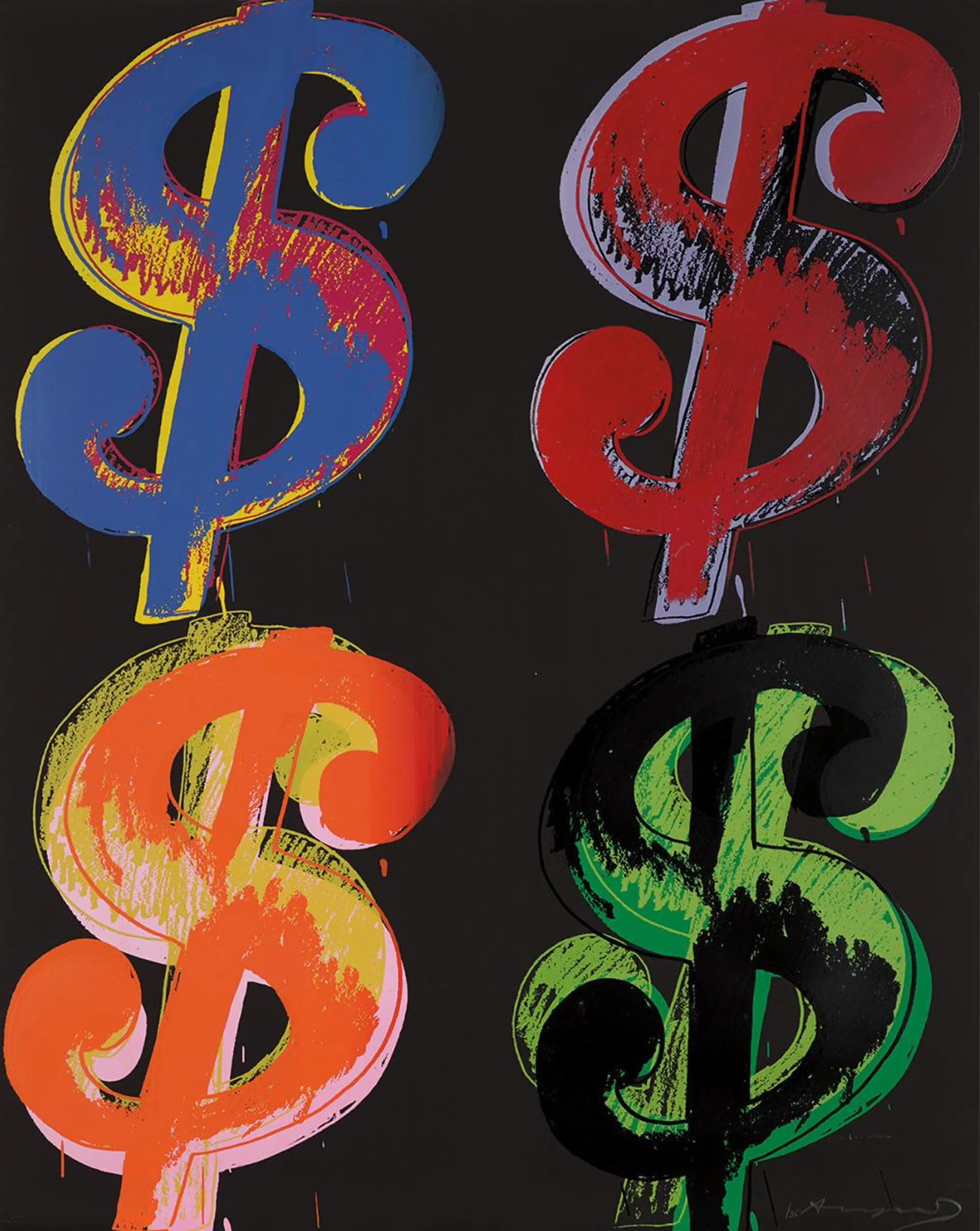
Andy Warhol, Dollar Sign Quad (F. & S. II.281), 1982.
What is a painting worth?
For much of history, the answer was straightforward: whatever the patron was willing to pay. Under the patronage system of the Renaissance, the fees of artists like Michelangelo and Leonardo were determined by the generosity of a pope or prince and their willingness to pay for materials like lapis lazuli and gold leaf. It wasn't until the Dutch Golden Age of the seventeenth century that art became something closer to a commodity, traded openly by a newly prosperous middle class in the same markets as grain and furniture. Price, for the first time, was shaped by demand. European Academies then introduced another layer of complexity: an official hierarchy of genres that ranked history painting above portraiture, portraiture above landscape, and priced work accordingly. By the mid-eighteenth century, the founding of Christie's and Sotheby's made sale prices public for the first time, and with them came an entirely new concept: the idea that an artist could have a market. That infrastructure - patronage, demand, cultural positioning, public sale - still underpins how we price art today.
Money, of course, matters. "When I was a student someone wanted to buy my work," recalls artist Darren Flook. "I asked my tutor how to price and they replied: 'How much debt are you in?'... my answer was the sale price." The anecdote is funny, but it captures something true: for most emerging artists, price is an immediate, tangible need divorced from ideals of purely aesthetic value.
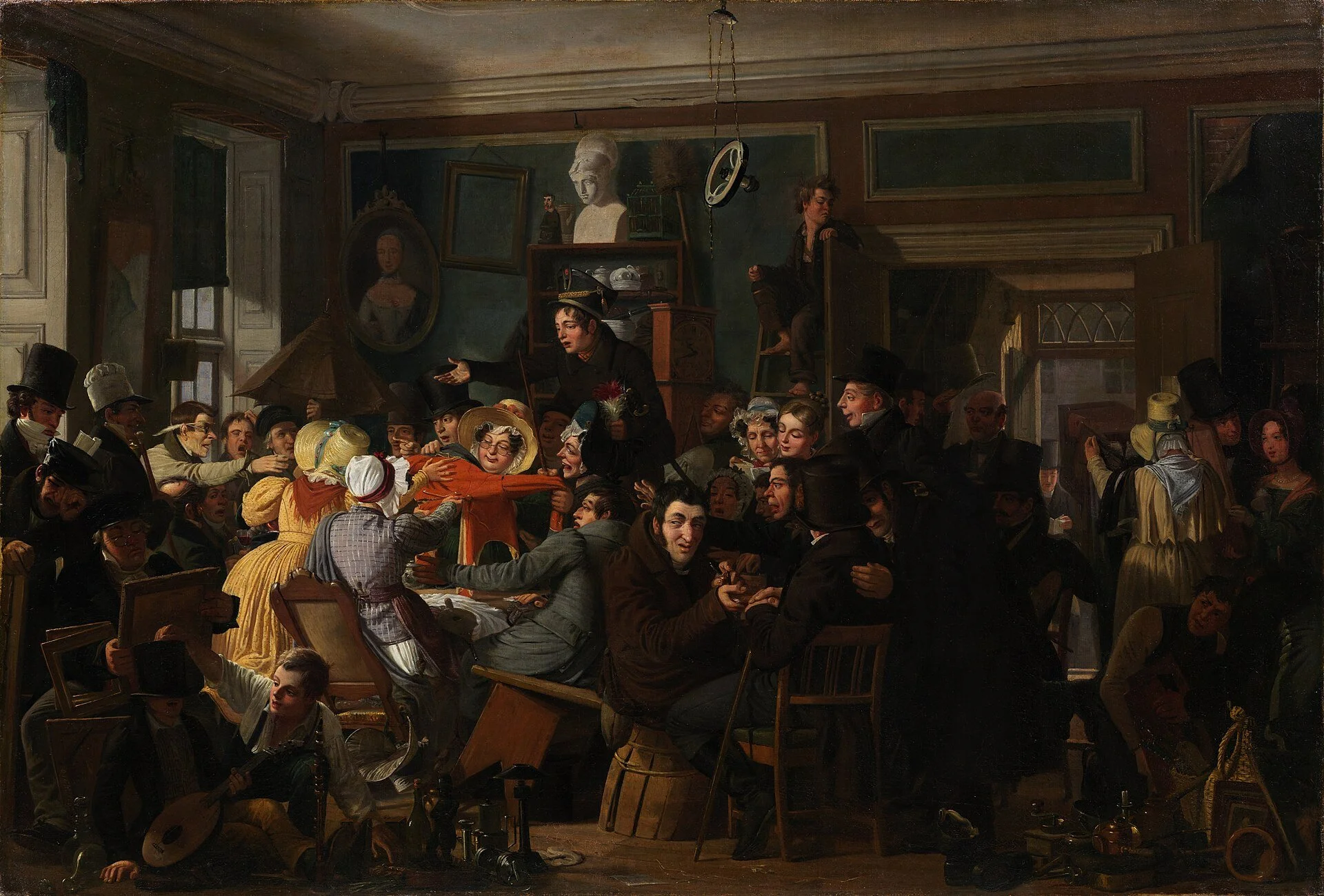
Wilhelm Marstrand, Auction Scene, 1835.
Traditionally, artists have approached pricing through one of three lenses: cost-based (calculating materials, time, and production costs), value-based (pricing according to the artist's own perception of the work's importance), or competition-based (referencing comparable practitioners). In practice, most artists draw on all three, though rarely in equal measure, and rarely cleanly.
A common starting point is the logic of production costs. As Lee Down writes in Mastering Art Pricing: A Concise Guide for Artists, artists often begin by calculating tangible inputs such as materials, labour, and overheads — pricing that at minimum reflects "the tangible cost of materials and time spent in the creation process." Down emphasises that pricing must also account for broader professional expenses including studio rent, marketing, and equipment. Artist Mingzhang Sun describes his own formula in similarly concrete terms: "the measurements of the artwork + the time and emotional energy + my art experiences + educational backgrounds." For artist Eva Dixon, a formula arrived at through conversations with trusted artists and curators has remained unchanged since graduation. "I use a formula and have stuck to it for years," she says. "I haven't raised my prices since graduation as I believe keeping them as they are makes my art more accessible, and those sales are often the most rewarding."
Yet cost alone rarely determines what an artwork ultimately sells for. Will Jarvis, founder of art-selling platform Gertrude, identifies a useful distinction between selling and placing work. "Early in a career, artists should be open to all comers — the priority is an accessible price point, building momentum, and getting work into the hands of genuine collectors who'll champion it," he says. "As reputation grows, the aspiration is for demand to outpace supply — at which point the dynamic inverts. Collectors start making the case for why they should own the work, rather than the other way around." Jarvis is candid about how rarely this shift is sustained: "it's actually quite rare for an artist to sustain that position. Even when they reach it, demand often falls away, and what you're left with is galleries working hard to maintain the appearance of scarcity — managing supply, managing expectations — rather than the real thing." As for the practical calculation, Jarvis lists the factors that typically come into play: "the time and effort that went into making the work, production and material costs, the artist's sales record and market buoyancy, scale, what the artist has coming up in terms of exhibitions, and — frankly — how much the artist needs to sell."

Quentin Metsys, The Money Changer and his wife, 1514.
Subscribe to our newsletter for more opinion pieces
The broader market plays a decisive role, and artists are frequently encouraged to position themselves relative to comparable practitioners. Down advises artists to "research various sources such as art galleries, online art marketplaces, and auction houses to understand the average prices for artworks similar to yours in terms of medium, size, and style." Not everyone welcomes the pressure this market logic brings. One artist, who asked to remain anonymous, describes a more instinctive approach: "I don't follow any strict formula when setting my prices. I try to keep them consistent and allow them to grow gradually as I grow as an artist — for me, it's mostly about common sense, aligning value with development, experience, and trajectory rather than applying a rigid system." They are particularly wary of gallery pressure to inflate prices rapidly: "feeling the pressure from a gallery to raise your prices by 30%, 50% or 100% because you are selling well, in just the span of a year… pricing should be part of a long-term strategy, not short-term speculation. This speculation is one of the reasons why the art market is where it is post-pandemic."
Psychology also plays a powerful role. Price functions as a signal: "a higher price can suggest superior quality, originality, or prestige," Down notes, while pricing too low can inadvertently communicate a lack of quality. Consistency matters too — sudden price drops can undermine collector trust and devalue earlier sales. This tension between economic pragmatism and artistic identity is something artist Manel Margalef navigates consciously. "Who I am as an artist and who I sell to are not dependent on each other," he says. "They can exist separately. This distance creates a necessary boundary — it allows the exchange between artist and collector to be ethical, aware, and respectful of time and dedication, not driven by pressure or trend." For Margalef, pricing is also a curatorial act in itself: "choosing who to sell to is just as important as deciding how much to charge. Sometimes refusing certain offers allows you to build a stronger and more reliable network of collectors who care about your work and your name in the long term."
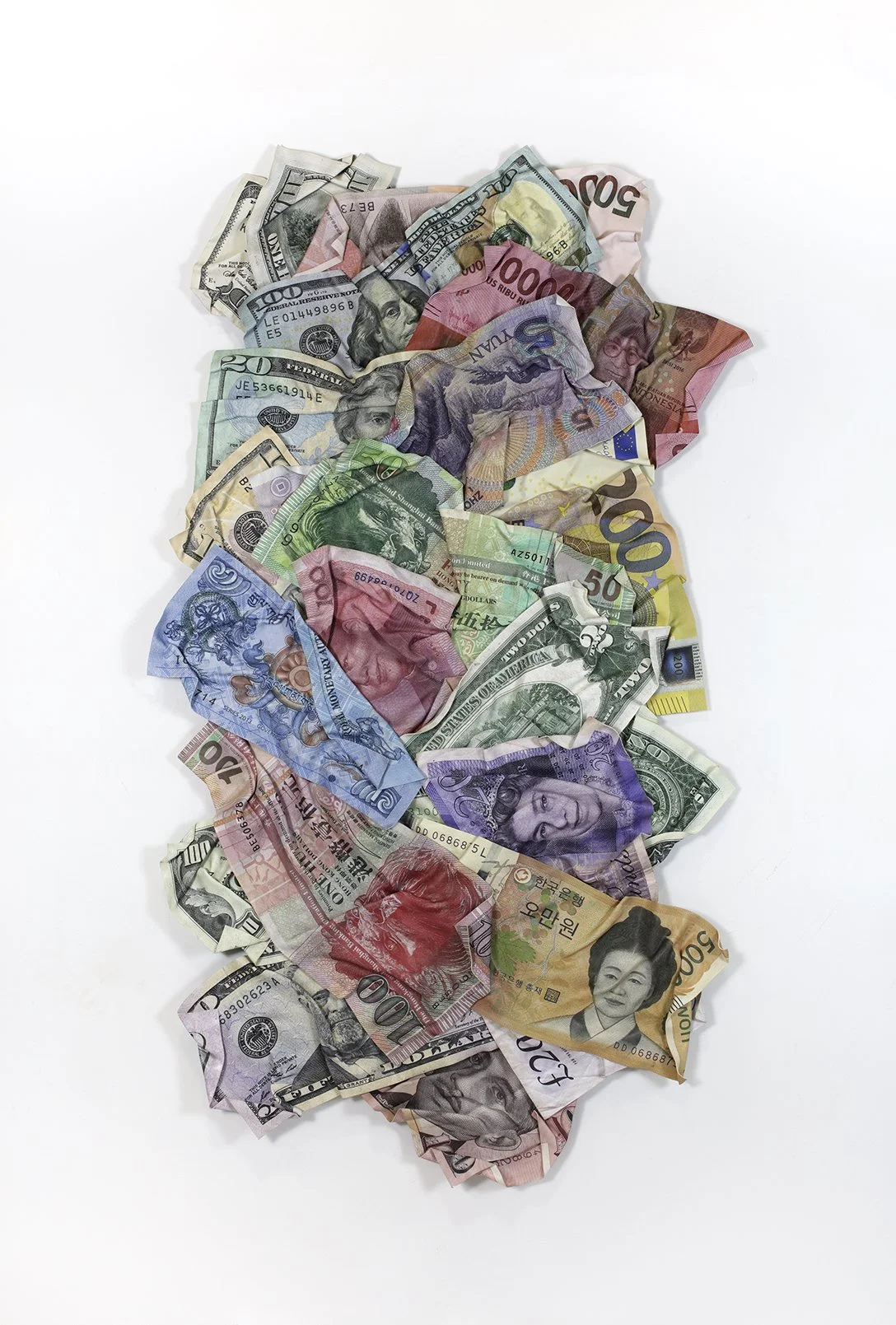
Paul Rousso, International Money, 2023.
This reflects something Bourdieu identified in his theory of the "avant-garde circuit": that emerging artists often prioritise peer recognition and symbolic value over immediate financial success, treating early pricing as reputation-building rather than revenue generation. But research suggests that even these strategic calculations may only partially explain how art prices actually emerge. Studies on newly graduated artists highlight the persistent gap between what artists believe their work is worth and what buyers are willing to pay — framed through the economic concepts of “willingness to accept” (WTA) versus “willingness to pay” (WTP). Artists frequently overestimate value due to emotional attachment to their work, a phenomenon behavioural economists call the "endowment effect": the tendency to place a higher value on things simply because we own them.
Most strikingly, contemporary research suggests that the intrinsic visual qualities of an artwork may have surprisingly little influence on its market price. A 2024 study published in Scientific Reports analysed over 34,000 auction sales and found that visual features explained only a small fraction of price variation. The strongest predictors were social signals: an artist's previous sales history, institutional recognition, and the prestige of the auction house. As the authors conclude, "social signals predict contemporary art prices far better than visual features." Raymond Salvatore Harmon, an artist, collector, and curator, would not be surprised. "The key to art valuation is based on the financial level of the social network of the artist," he argues. "Proximity to wealth is, and always has been, the key indicator of an artist's financial success. Commercial valuation begins with the consideration of: 'What can my collectors afford to pay?' If you want to increase your prices, you have to increase the social network you exist in as an artist to include collectors of a higher net worth than those you are currently selling to. Going from £500 to £50k means going from collectors that drive Toyotas to those that drive Bentleys... No one making £100k a year is spending £50k on a piece of art."
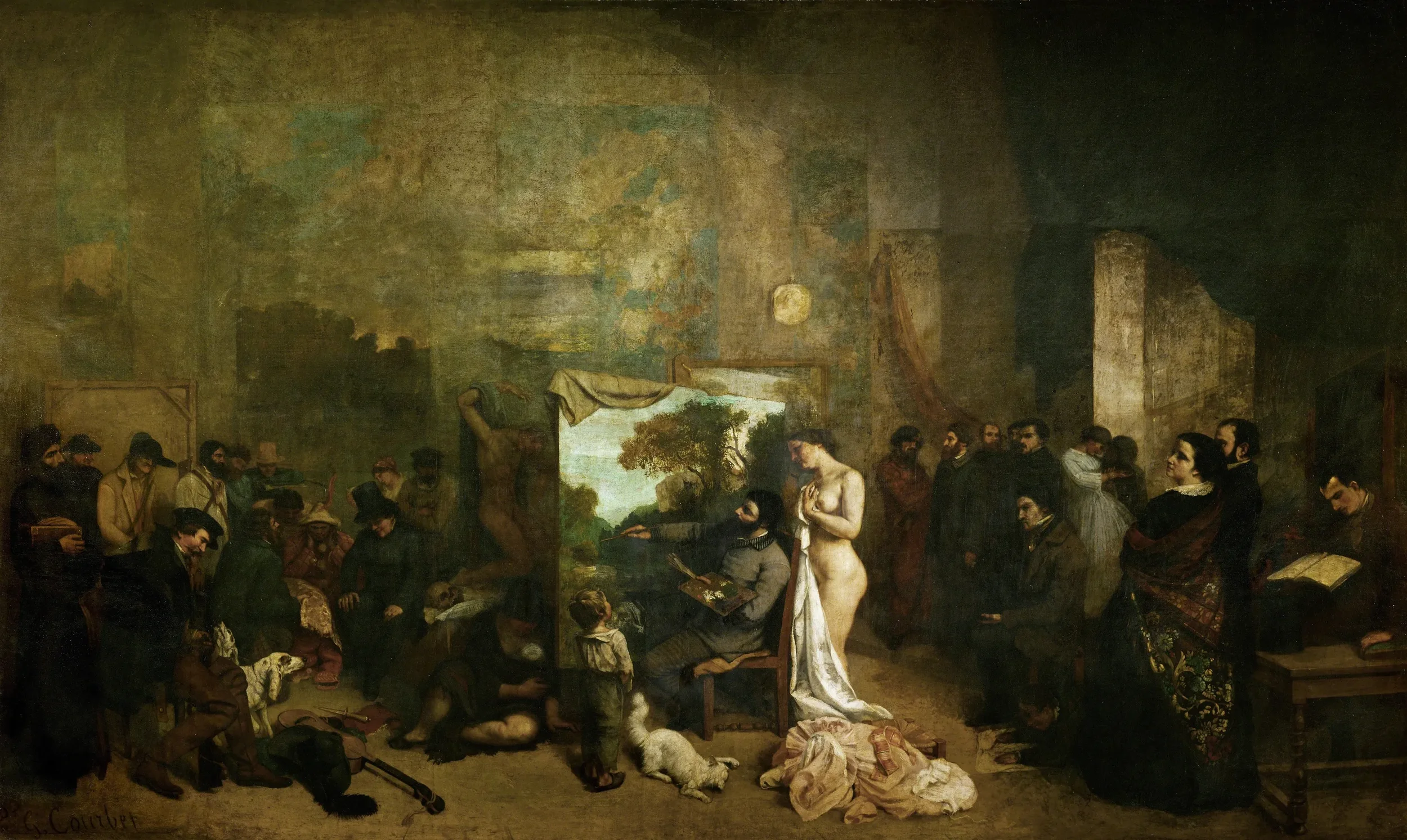
Gustave Courbet, The Studio, 1855.
Subscribe to our newsletter for more opinion pieces
Survey data from exhibition visitors confirms the same gap from the other side: buyers were consistently willing to pay less than artists expected, revealing a significant and persistent mismatch between artistic self-valuation and market demand.
Pricing artwork will never be a clean science. It sits at the intersection of material cost, market positioning, psychological signal, and social network, each pulling in a different direction, none of them fully within your control. What research and experience both suggest, however, is that the artists who navigate it best are those who approach pricing as a long-term practice rather than a series of reactive decisions. That means building a formula early and sticking to it, resisting pressure to inflate prices faster than your market can genuinely support, and being honest with yourself about who your collectors actually are — and who you want them to be. It means understanding that price communicates before a buyer ever speaks to you. And it means accepting that some of what determines value — institutional recognition, social proximity, auction history — exists largely outside your studio. The parts that don't, however — consistency, intention, the relationships you build and the offers you choose to refuse — are entirely yours. Price is not primarily a reflection of what your work is worth. It is a reflection of where you are in the world, professionally, socially, and institutionally; and where the people around you sit financially. That is not a cynical conclusion, but it is a realistic one, and perhaps more useful to artists than any formula.