

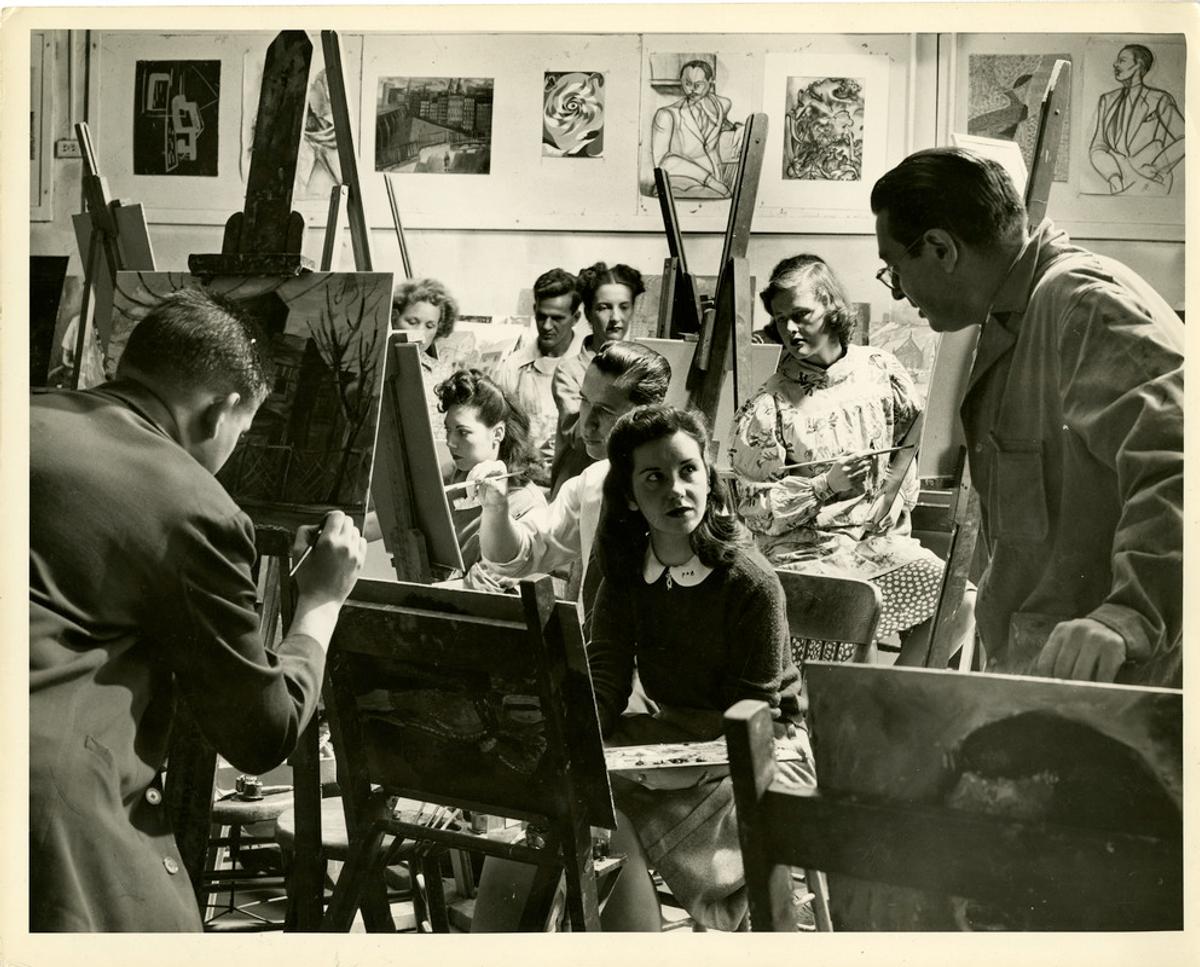
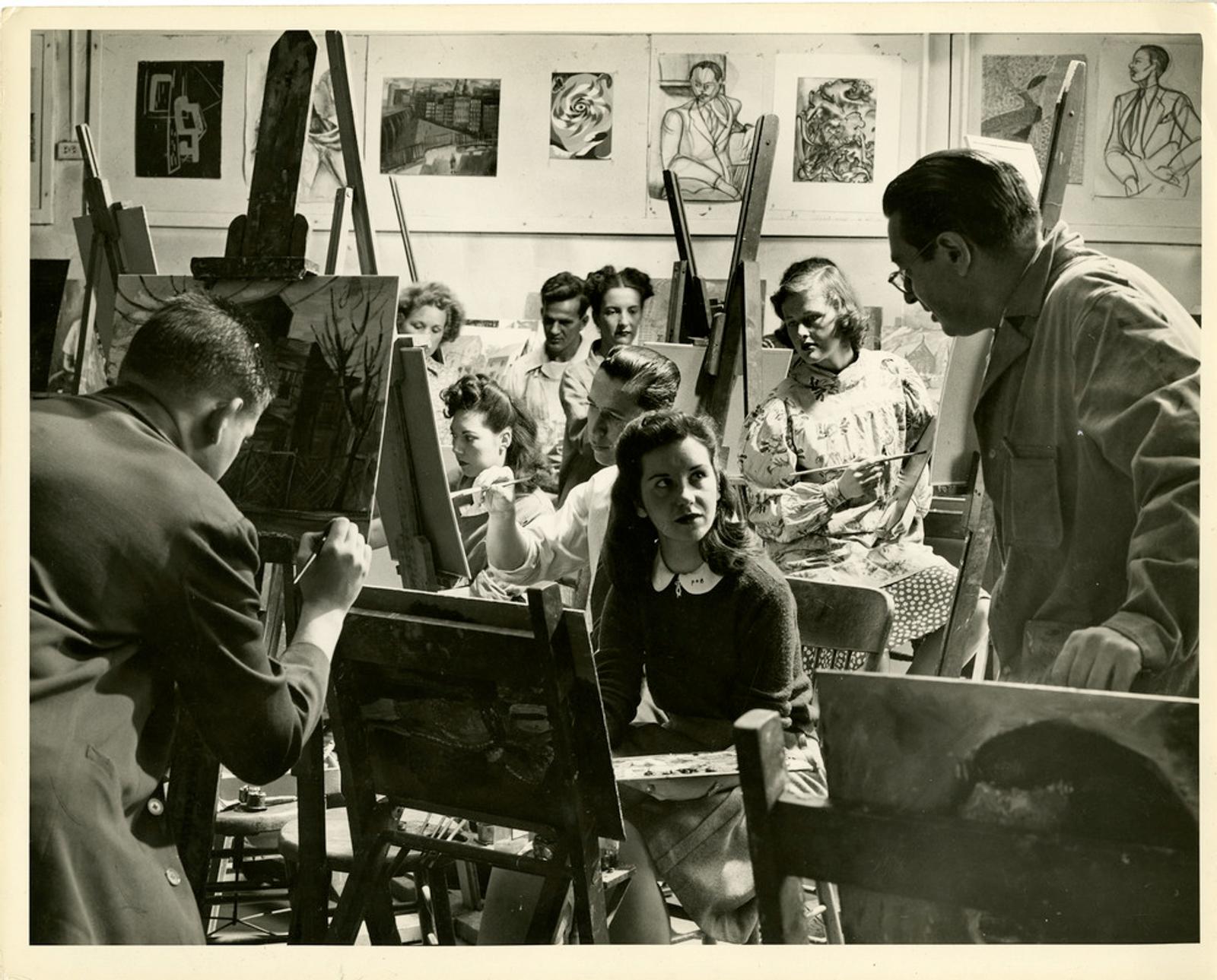
Turns out that our informal assessment was surprisingly archetypal. According to DACS’s 2024 Artist Earnings Survey, UK visual artists have a median self-employed income of just £12,500 a year, around 47% lower than a full-time minimum-wage worker, with over 80% describing their earnings as “unstable” or “very unstable” (who knows how much of this is due to avocado toast). Earlier research for Artfinder and a-n showed that roughly 72–82% of UK artists earn under £10,000 a year from their art, a figure worsened during the last decade. Crucially, for the “just do an MFA” camp, DACS noted that most visual artists already have a degree-level qualification or higher, but earning more qualifications does not increase their art income: artists with Master’s degrees or PhDs typically report lower median art earnings (around £7,500) than those whose highest qualification is a BA (£12,500). The class anxiety at the table is also statistically on point: more than half of UK visual artists (53.3%) come from the most privileged socio-economic backgrounds, and artists from less privileged backgrounds earn around 40% less than their better-off peers (now is perhaps a good time to mention that one of three self-taught artists at the pub is the child of a YBA - you will be surprised to learn that they are also the one with the gambling and OnlyFans problem).
“I wouldn't be where I am without art school.... But then again I wouldn't be where I am without art school.”
On the graduate side, creative arts graduates are not especially unemployed, but they are precarious. Prospects’ 2024/25 “What do creative arts graduates do?” report shows that 82.7% of creative arts graduates are in work 15 months after finishing, slightly higher than the all-subject average, yet only 49.8% are in full-time jobs and just 58.6% are in “professional-level” roles; fine art graduates have the very lowest professional-level employment rate at 46.9% (even at our table, five of the artists are employed in other industries, ranging from coat check to paralegal). Typical salaries sit in the £21,900–£30,900 band, mostly below the national graduate average, and fine art grads cluster towards the bottom of that range. The British Academy’s 2019 analysis of arts and humanities graduates backs this up: around 88% are employed, essentially the same as STEM grads - and while their earnings growth catches up over a decade, the short-term reality is low pay and high “portfolio career” chaos.
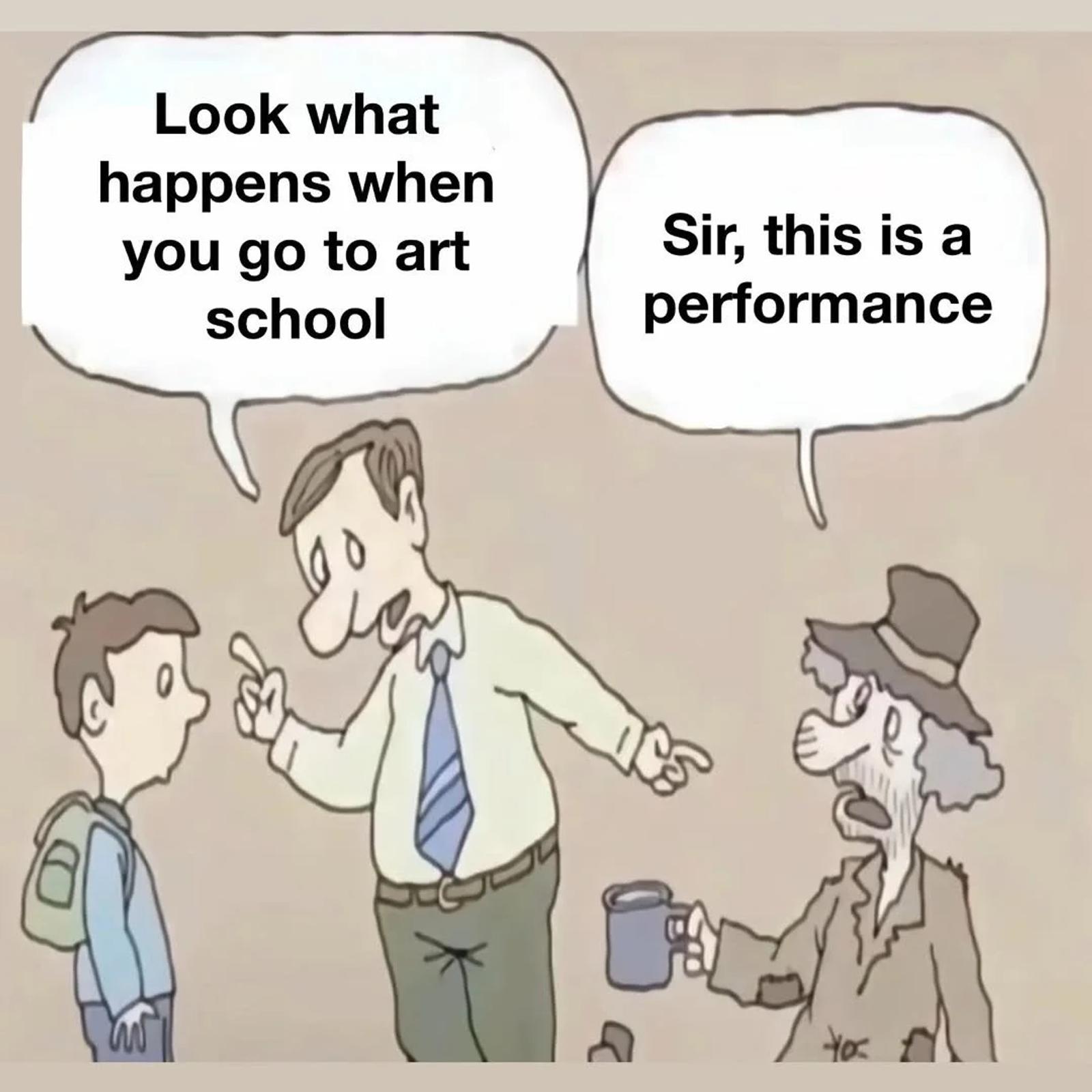
Image courtesy of Freeze Magazine and Cem A.
So – what of the art school in all this?
For some people, it really is the golden ticket the prospectuses promise. “It felt like a no-brainer in a. getting out of homelessness and b. furthering my career and opportunity.” says artist Channah Abba, who grew up in youth homeless accommodation and treated art school as both escape route and beginning. “I would 100 percent recommend art school, especially to kids who come from my situation and background… nothing provides you the stability and opportunity like a university, an amazing location, and connections like art school can.” A second artist concurs: “Art school saved my life.” they say. “I met people who thought like me for the first time. I had a tutor who basically dragged me through the first year. Without them I would’ve dropped out or worse.”
“The structure that rescues one person can just as easily be the thing that dismantles another”
That being said, the structure that rescues one person can just as easily be the thing that dismantles another. Artist Clemmens Grömmer went in drawn by “the notion of being able to develop and grow as an artist through community and education,” and found himself colliding with the softer, unspoken curriculum: the “level of imposter [syndrome] and to feel less of a person during the first years,” and the discovery of “how much cultural capital values within the discourse.” Studying in Vienna with “bad English as well as art vocabulary” left him “often feel[ing] incapable of articulating what I wanted to say.” What he took away, in the end, was that “art school managed to gain and destroy confidence” more or less simultaneously.
A similar double-bind shows up in artist and scientist Nina Gonzalez-Park’s account. She arrived from a completely different life, having originally studied neuroscience and worked on human research trials. Art school, for her, was a serious career pivot. The shock wasn’t so much the workload but the social temperature: “A heads up on the amount of socialising and networking would’ve been nice… I’m an introvert by nature, so it was a steep learning curve regardless,” though she concedes she “quickly learned that meeting people and genuinely connecting was invaluable.” She “worked like a nutcase through [her] two years” because there was no safety net waiting on the other side: “I hustled as much as I could and made sure to stand out.”
Even among the success stories, the emphasis rarely lands on pedagogy. Moroccan artist Loutfi Souidi fought three times to get into INBA Tétouan because “almost all the Moroccan artists I admired had graduated from that school.” He describes the real gift as “having studio space and time to focus on my work,” and being “surrounded by people like yourself, but with different visions and ways of seeing the world.” But when asked whether art school prepared him for the realities of being an artist, he answers: “Not really… Once you graduate, you’re on your own.”
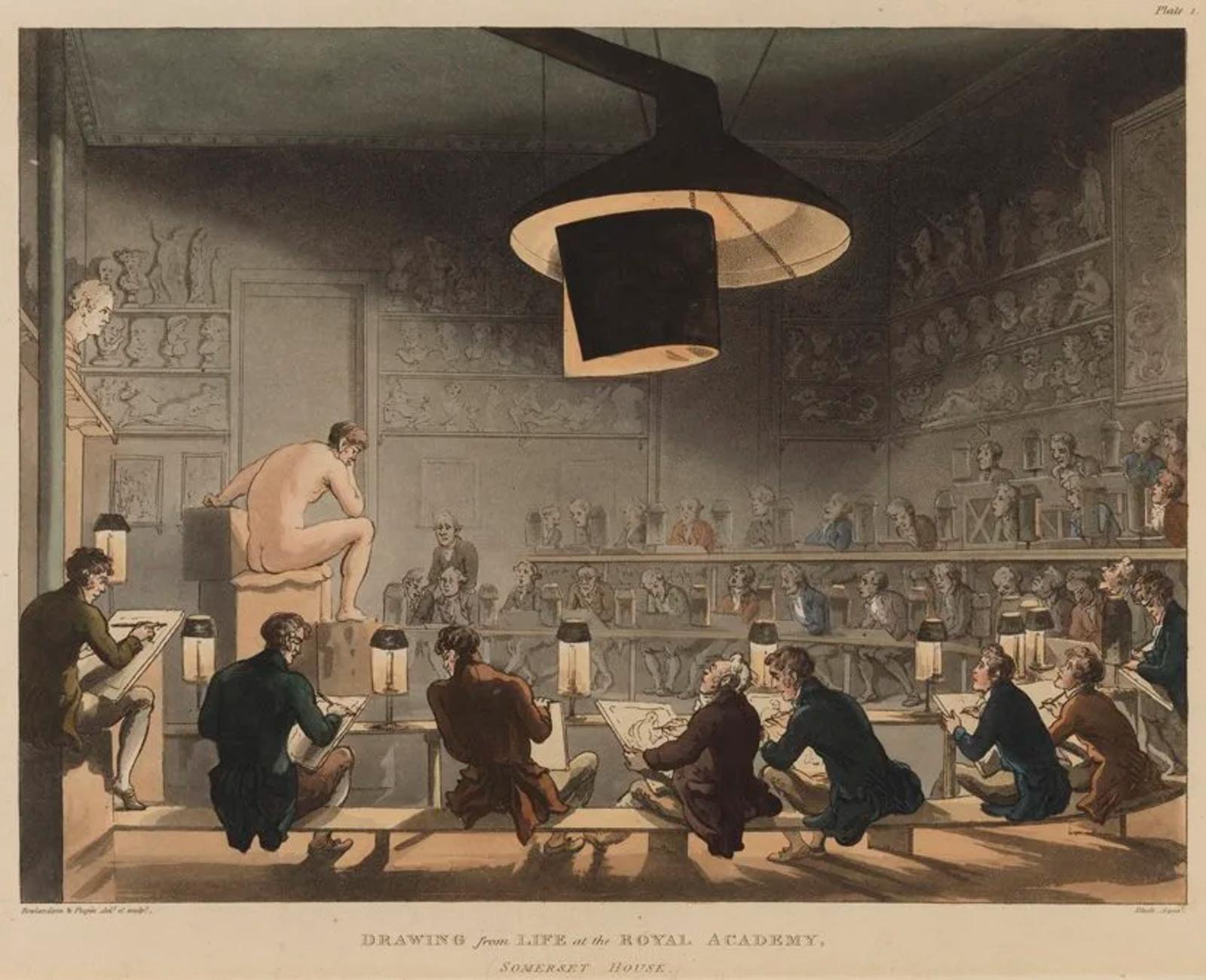
Drawing from Life at the Royal Academy, Thomas Rowlandson, 1811.
Then, of course, there are the people for whom the institution failed to deliver not only after but during their studies. Asked why art school ever felt like a good idea, artist and Creative Flair founder James Carter replies: “Beats the fuck outta me now!” He describes having studied art through college and foundation, then entering university out of interest, then for a “sheet of paper saying I actually knew what I was talking about,” and finally as a way to be in London. Now, he says, “university for this area of study for me is [a] complete waste of time, and I’m proven right in this statement each time I attend a lecture.” He wishes he’d known “how much politics affects your study”, citing “teacher strikes, reform programmes, and a severe lack of funding,” and recounts a student in his first fortnight telling him he should kill himself. When I ask whether he’d recommend art school to someone starting out, he answers: “Honestly no, it is a waste of time if you actually have ambition… They will not teach you how to live off your art for a career.”
Luckily, there are still plenty of options for those who want to sidestep the system entirely. Sam Wootton, a self-taught painter who has worked for Gucci, Sandro, Axel Arigato and the Tate, deliberately skipped art school. “I didn’t go… because I was pretty set in the idea that I was going to pursue art irrespective of whether I studied or not,” he explains. “I studied English Literature at KCL, and always found time to make, and sell, paintings. I knew I could do this, I knew the passion wasn’t going anywhere.” At first, being self-taught “felt like an augmentation granting more freedom in movement, both institutionally and within my practice. Fewer walls or boxes.”
As his practice developed, though, “the blind spots have just become deeper, and the freedom I have is underpinned by a sense of being perpetually one step behind.” Where his peers “intuitively know where these ideas sit in relation to others,” he’s “scrambling in the dark a bit to find the most reasonable, or informed, way in.” That scramble has become a method: “I’ve taught myself to trust how I am affected by art… My only barometer for good work is work that stirs my spirit.”
“When somebody starts using [artspeak] I know they are an art-school asshole”
Another self-taught artist similarly tells me “the only regret I have about not going to art school is I really struggled at first [to] understand how to talk about my work. Everyone else seemed fluent in a language I didn’t even know existed… I love my work, but I had to explain things that are very intuitive to me with terms and movements a lot of people assume you know because of art school.” They had to spend a few years “reading Wikipedia articles, listening to podcasts, asking questions” in order to understand “shit like Adorno… but I didn’t need art school for that. I could just read books.” I ask if not being taught artspeak has held them back in any way, to which they answer: “fuck no. It’s made me better at being able to tell when somebody is a good artist because they don’t use overcomplicated words, they know how to speak about things like normal human being[s]… When somebody starts using [artspeak] I know they are an art-school asshole.” Neither they, nor Wootten, regret avoiding the academy: “I don’t wish I had gone to art school.” says Wootten. “I think I’d have been delayed in finding my voice as I’d have had the kitsch stamped out of me too soon.”
It’s tricky to decipher whether art school makes you a better artist. “You can tell when someone hasn’t gone to art school,” says one MFA-holder. “because the work just isn’t as good. I don’t say this because I think people who can’t afford to go to art school are stupid or incapable of having a discerning eye, I just don’t think you can make good art unless you know the sort of things they teach you at [their art school]. There’s a reason they’ve produced the likes of [a list of - in this interviewer's humble but correct opinion - very bad but very famous artists].”
I ask them if they think they might believe this precisely because they went to art school. “Doesn’t [your art school] profit from you thinking this?” I inquire. “[Do you not feel] like there is an incentive to have more people from a group think that their group is better, so that more people will want to join that group?”
“When you put it like that,” they reply curtly, “you make it sound like a cult.”
Moving on from any snide remarks I could make about well-fitting footwear, I decide to ask someone whose job it actually is to sit between artists and the market: art advisor Ravi Francis.
He’s not especially sentimental about where people studied, but he is very clear that education does shape the playing field. “There are differences in how trained artists and self-taught artists build their careers, especially in the beginning,” he tells me. Artists who come out of formal programmes, he says, “usually start with a built in eco system - professors, visiting curators, etc. The language of the art world is a forever evolving language and they’re just exposed to that language early on.” Self-taught artists, by contrast, “do have to figure everything out by themselves. They don’t have institutional norms to rely on so their work tends to have a stronger personal voice. It’s always fresh to see that in an artist's work.”
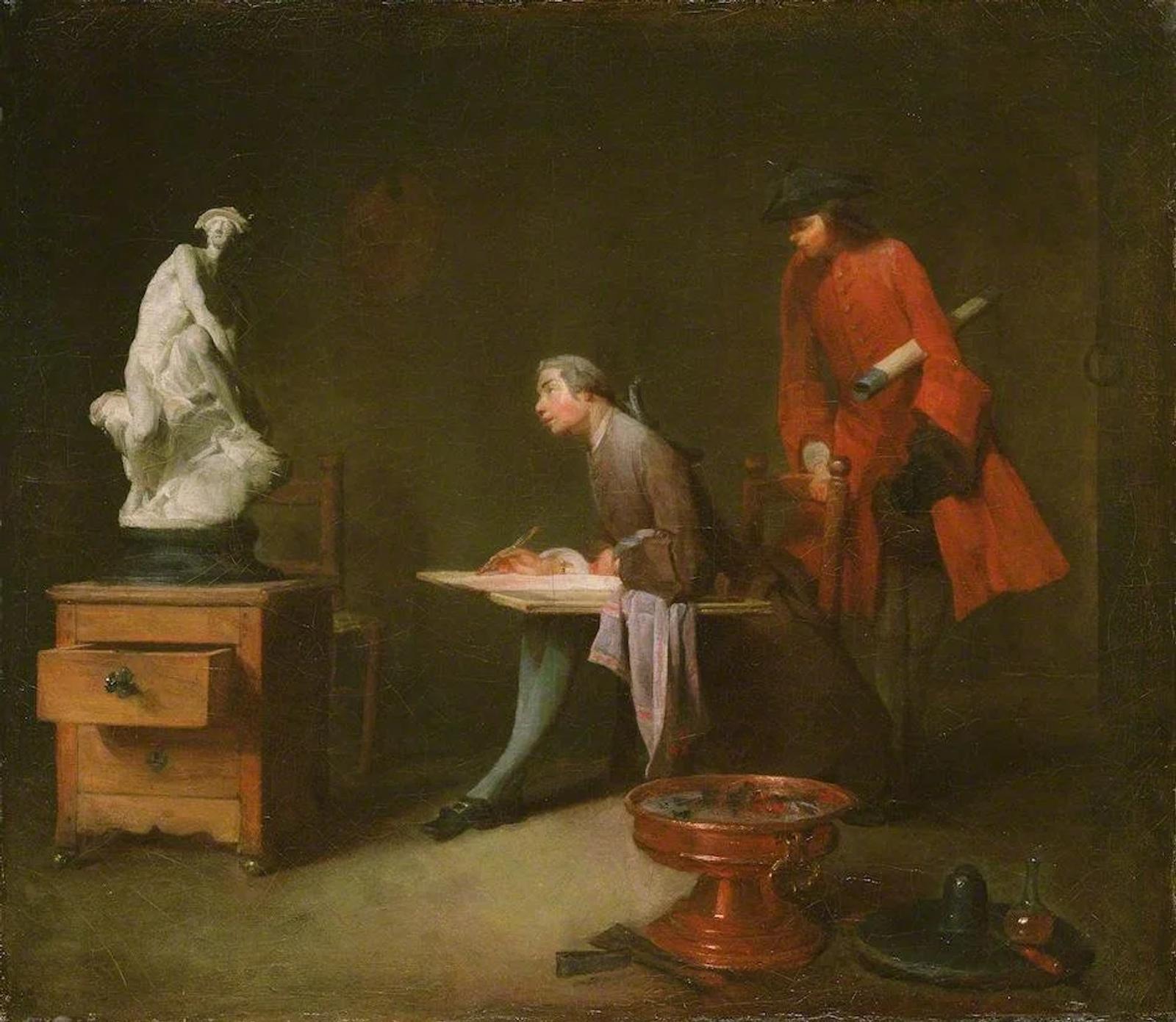
Jean Baptiste Simeon, The Drawing Lesson, c. 1734
Another art advisor agrees: “people get their foot in the door plenty of ways from family connections, to sharing drugs at private views… what matters is what they do with that once it’s happened.” When actually looking at emerging artists, the CV is basically background noise: “Once someone gets a show, no one cares if they learned colour theory at the RCA or from a YouTube tutorial. The work is either alive or it isn’t.”
What both advisors do wish art schools would take more seriously is not the myth of the genius, but the boring machinery that lets said geniuses pay rent. “If it were up to me I’d teach artists about how the business side actually works. plainly and honestly, not to kill creativity but just to give them a better shot at sustaining it,” says Ravi. “Not because I want artists to be ‘commercial’ but because I’d want them to have all the tools to survive in such an industry. There’s too many talented people that get overwhelmed by bridging the gap between school and the real art world.” The second advisor concedes that while “galleries love a tidy CV” the truth is collectors are not buying degrees. “I’ve placed self-taught artists in major collections because their work made people stop breathing for a second. That’s what matters.”
Earlier this year I asked a curator that hired me for a museum consultancy gig if she had checked my degrees (a BA in English and History from the now-defunct New College of the Humanities and an MA in the History of the Art Market and Collecting from Buckingham) before she reached out to me, and she told me no. “I’m not interested in where you spent the years of your life listening to [a particularly unpleasant German work for sycophant] academics,” she said at the time. “I looked at your website and I liked your work.”
I hit her up again and ask if this is how she picks artists to include in her museum. “I look at the work.” she replies. “I look at the person. The school is not the work is not the person.” Another Los Angeles-based curator adds: “if anything, a lot of young collectors are more interested in buying self-taught artists because it tells a particular narrative of resistance. [In the US] we like a story, we like identity, and if part of that identity is saying fuck the system that can be a huge boon.” A third concedes: “Nobody believes in the myth that just because you don’t have an art degree you are not an artist any more.”
I can’t speak for the art school post-grad experience (had I any aptitude for making rather than merely bitching about art, I would not be a critic). However one anecdote I tell often is on the day I received my MA in the History of the Art Market, I logged onto Indeed to see a litany of extremely good jobs (including curator of the Imperial War Museum and senior press officer for the Tate) and only applied to one because… well, it would just be so embarrassing when I got accepted for all of them and had to turn down the others (lol). Six months later I was applying for coat check attendant jobs at the V&A (and still not getting call-backs).
“More people with degrees meant less advantage per degree”
This naiveté is something I see reflected in many post-grad artists today; I, like them and most of the Western world until Covid, believed that if you put your head down, studied hard, and got a degree or two from a good university you would meritocratically be afforded a stable source of income. As one artist puts it, “I thought I was going to graduate and get a hundred shows and sell so many paintings and then I got nothing for so many years. I had no money and I had lost my only studio space. I didn’t know how to sell things so I just worked in a bar until finally a collector found me on Instagram and things picked up again.” The 2016 ‘wage puzzle’ study by the IFS showed that as the proportion of degree-holders more than doubled between early-1990s cohorts and those born a decade later, the so-called “graduate premium” - the wage and employment boost graduates enjoy - did not increase accordingly. In effect: more people with degrees meant less advantage per degree.
Many years later, I can safely say that my degrees never landed me a job, but the skills and knowledge I received from participating in higher education have been absolutely invaluable to the gigs I have been offered. What I am not so sure about is whether this is applicable to something like art studies: it’s clear that plenty of good art is made by people who haven’t read Adorno or never been taught to mix their own oil paints. Plenty of bad art is made by people who have.

Video courtesy of Freeze Magazine and Cem A.
We have all been oversold the value of a degree, but what makes art studies unique is that the degree is, at best, a scaffolding: you can build something brilliant on it or discover you never needed the scaffolding to begin with. The testimonies I gathered circle the same point from wildly different angles. Art school might give you “stability and opportunity,” or it might give you “blind spots” and “imposter” feelings; it can “save you time,” “destroy confidence,” or simply give you a room full of people to argue with until you figure out who you are. It can change your life or it can waste your money; sometimes it does both.
“A degree can open a door, but it cannot walk through the door for you. It cannot make your work good, or urgent, or alive”
None of this cancels the simple truth that emerged from every advisor, curator, and artist I spoke to: the work will out. A degree can open a door, but it cannot walk through the door for you. It cannot make your work good, or urgent, or alive. As one advisor told me, “no gallery or collector has asked for a work by somebody from a particular school since the nineties. Those days are long gone. What people want now is work that speaks to them.”
Or, as Carter puts it, “I wouldn't be where I am without art school.... But then again I wouldn't be where I am without art school.”
Comments
Leave a comment