dialogue
Norberto Spina | Artist
March 2026
4 min read
Norberto Spina came to painting the long way round. He resisted the label for years, testing video and installation not to escape the canvas but to circle back to it from unexpected angles, letting those experiments reshape how he thinks about space, light, and the body moving through a room. The Royal Academy deepened this further, transforming paintings from isolated objects into presences shaped by their environment. Now, given the opportunity, he builds walls and partitions, letting painting bleed into architecture and back again.
Spina’s photographic references are chosen for what they withhold, images that carry tension, that resist easy reading, that bite. The canvas becomes the place where the ordinary undergoes transformation, emerging as something even he didn't anticipate. At Cassina Projects, this impulse took architectural form: a room built within the gallery held a single painting, La promessa, 2025, simultaneously monolithic and intimate, personal yet open to a stranger's associations. His figures, when they look back, collapse the comfortable distance between painting and viewer, drawing the body close, then pushing it away, letting detail dissolve into abstraction and resolve again. The encounter is never passive.
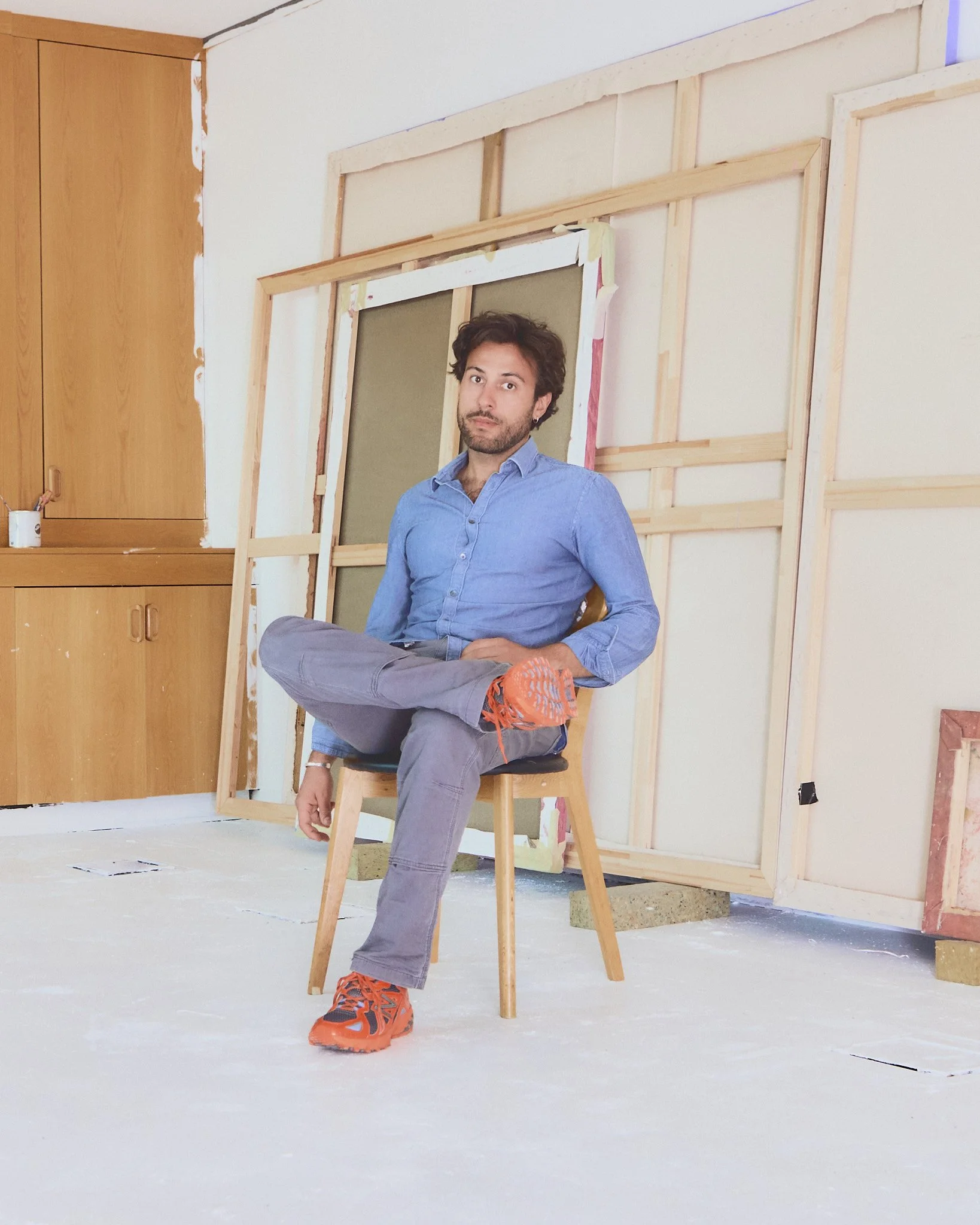
Norberto Spina. Photo by Sarah Larby.
While painting has been central to your practice so far, are there other mediums you feel drawn to, and what might they allow you to explore that painting cannot?
”Painting has always been at the core of my practice, even as I resisted being defined as “just” a painter. Gradually, I came to accept the idea of being a painter through and through. What once felt like a limitation has become something I can fully inhabit and push from within. Over the years, I’ve explored other media, particularly video and installation. Not so much as alternatives, but as ways of approaching from different angles the same atmospheres I was trying to resolve in my paintings. While those works didn’t always stand independently, they reshaped how I think about space and the boundaries of the painted surface. Now, when I have the opportunity, I like to engage space more directly: creating walls, partitions, entire rooms. I’m not trying to stage painting, but to let it leak into the architecture and back again.”
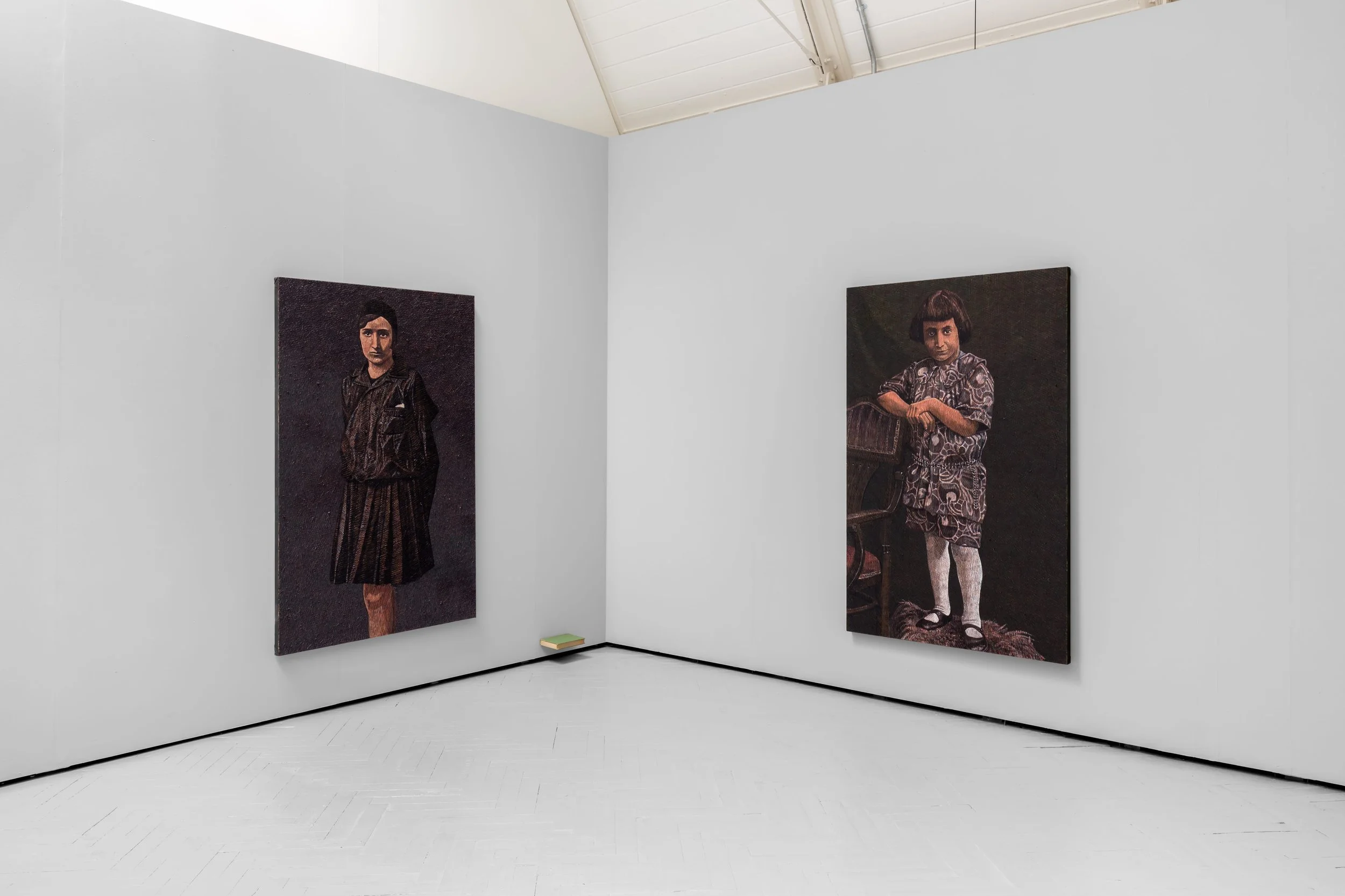
Installation View: Royal Academy Schools Show, 2024. Photo by Jack Elliot Edwards. Courtesy of the artist.
Left: Norberto Spina, Laddove l’acqua ristagna, Oil, acrylic and marker on canvas, 170 x 110 cm, 2024.
Right: Norberto Spina, Nel nome del padre, Oil, acrylic and marker on canvas, 170 x 110 cm, 2024.
How did your time at the Royal Academy shape or expand your practice?
“At the RA, my understanding of painting expanded beyond canvas itself. I began to think about how painting operates in relation to space, how it is shaped by light, surrounding works and the movement of the viewer.
This shifted my approach significantly. I stopped treating paintings as isolated entities and started considering them as presences within an environment. Scale, distance, and placement became an integral part of the way I think about to my work, rather than secondary decisions.
The RA also immersed me in a new context, exposing me to diverse art networks, critical dialogues, and alternative ways of making, which broadened my sense of what is possible within my practice.”
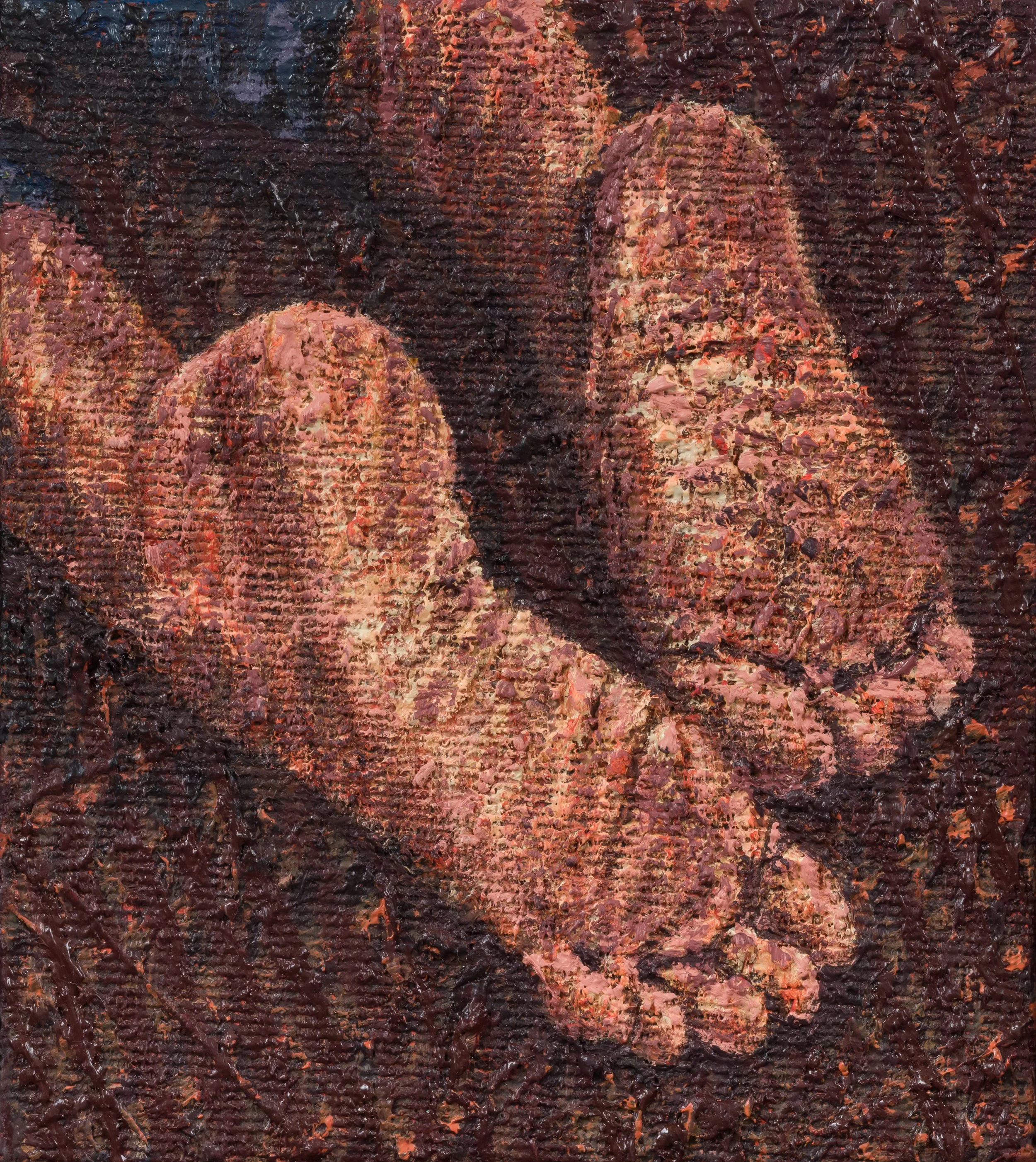
Norberto Spina, A piedi nudi, Oil and acrylic on canvas, 12 × 10.5 cm, 2025. Photography Jack Elliot Edwards. Courtesy of the artist.
Some of your paintings appear to begin with photographic references, what draws you to a particular photograph, and how do you decide it is worth expanding into a painting?
”I choose images that don’t settle, seeking an evocative tension, an ambiguity, something that bites at the viewer, something that resists. I find that reality, even the ordinary kind, is often the most surprising thing one can imagine. I like the idea of stealing from it, but remaining true to my personal story. For me, pictorial space has always been a space of reinterpretation, a place where the initial image becomes something else, almost as if through an alchemical process of transformation that still amazes me every time.”
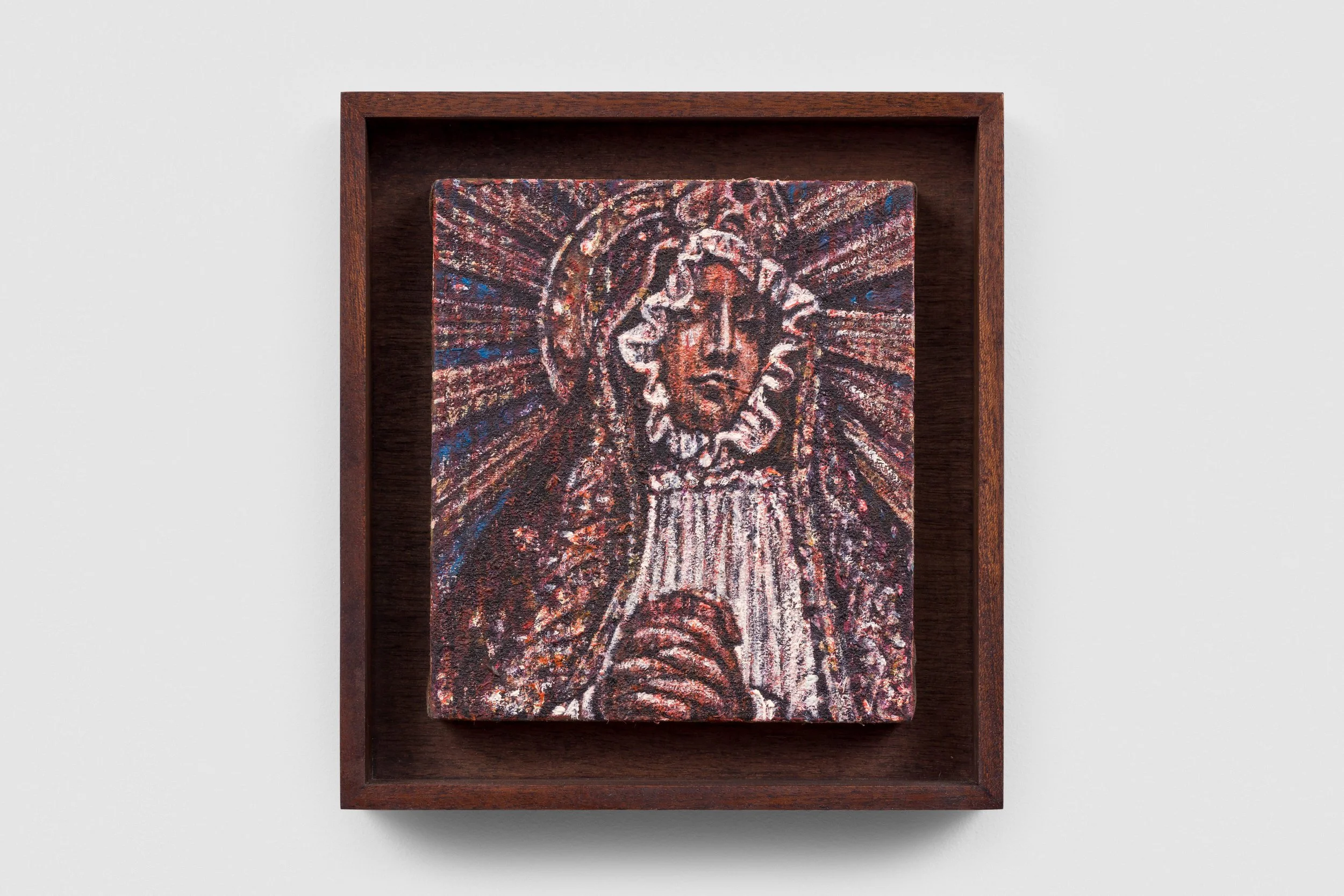
Norberto Spina, A Milano una volta c’era la nebbia, Oil, acrylic and marker on canvas, 13.5 x 12 cm, 2024. Photo by Jack Elliot Edwards.
In your exhibition with Cassina Projects, you introduced a room within the space containing a single work, La promessa, 2025. What led you to make that decision? What does that kind of isolation do to the work, and to the way it is experienced?
“I was drawn to the idea of creating a space within the gallery, something akin to a heterotopia. A kind of “non place” reduced to its essential structure, yet capable of holding multiple identities at once. From the outside, it appeared almost as a threatening monolith, while inside it could evoke very different associations: a dorm room of an old college, a tack room, or even a bedroom in a country house belonging to one’s grandparents.
The strips of wood I chose for the installation were rooted in my family memories, grounding the structure in intimate experience while reinforcing a sense of ambiguity. I wanted the space to amplify the atmosphere of the painting, acting not merely as a container but as an extension of it. Isolating La promessa, 2025 removes noise but demands a different kind of attention. Entering the space becomes part of the experience, almost like crossing a threshold into another psychological or emotional dimension.“



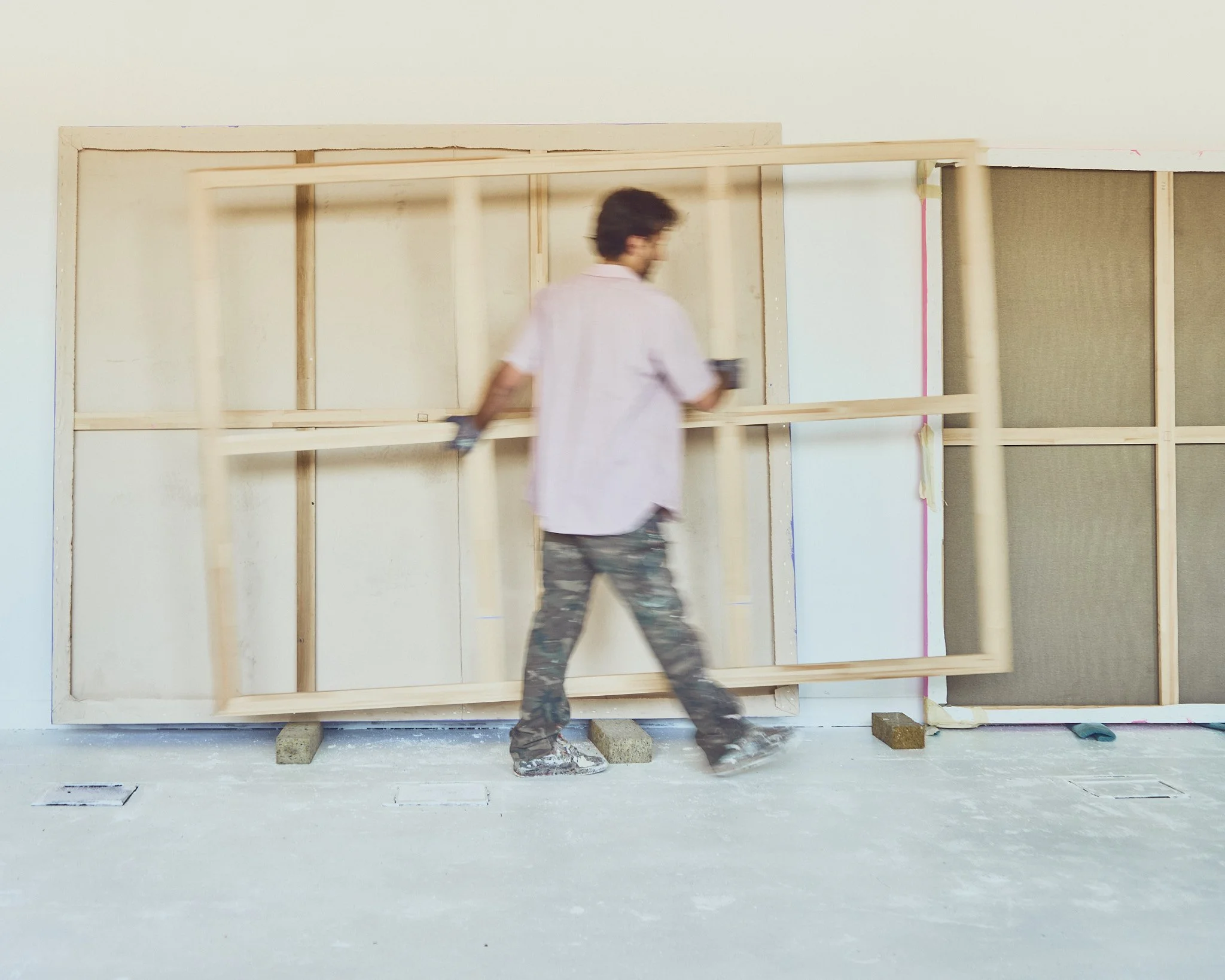
Norberto Spina. Photo by Sarah Larby.
What kind of distance do you want between the viewer and the work? In some pieces, such as Compagni di giochi, 2025, Nel nome del padre, 2023, Laddove l'acqua ristagna, 2023, and Portrait of a boy, 2025, there is a sense that the figures might be looking back. How do you think about that dynamic?
“The distance between viewer and painting isn’t fixed. It shifts depending on how the figures meet your gaze. When they look back, the image stops feeling distant and begins to confront you.
I’m interested in how the viewer physically relates to the work. Ideally, I want the viewer to be drawn into a movement of approaching and stepping back. At times, I want them to come very close to the painting, almost to the point of touching it, creating a sense of intimacy and a more personal, tactile engagement. In other works, I want the viewer to step away, to grasp the image in its entirety, and then move closer again to discover details that can appear almost abstract.
In larger works especially, this oscillation between near and far becomes essential, heightening the tension between figuration and abstraction, and hopefully viewing into a more dynamic, embodied experience.“
Recommended