dialogue
Marco Bizzarri | Artist
January 2026
7 min read
Marco Bizzarri reflects on landscape as an archive of time, shaped by his upbringing in Chile and deep attentiveness to the Atacama Desert, where light, dust, and vast horizons cultivate a practice rooted in silence and contemplation. Relocating to the UK sharpened his sensitivity to shifting light and perception, reframing how colour and atmosphere shape our emotional relationship to place.
In Bizzarri’s paintings, dust becomes both material and metaphor. Layered, splattered, and partially erased surfaces echo the desert’s suspended particles, softening images while preserving traces. This tension between concealment and revelation holds the work in a state between presence and disappearance, where absence persists rather than vanishes.
Working from memory and displacement, Bizzarri returns to abandoned interiors and rural spaces as sites where time slows and light reveals what endures. Painting becomes an act of translation, transforming photographs and recollections into atmospheres of stillness, where decay, resistance, and latent histories quietly surface.
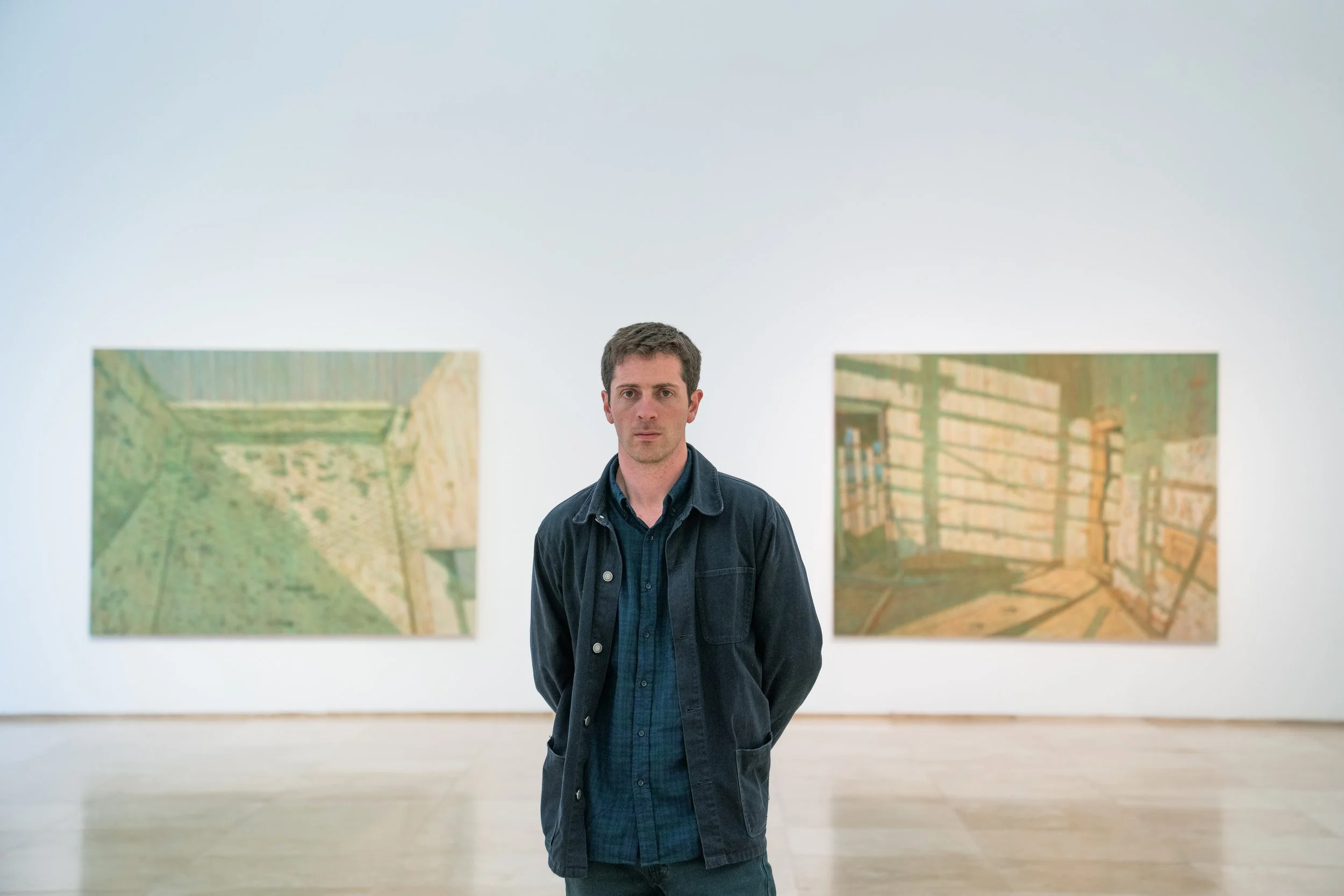
Marco Bizzarri. Photo by Patricio Diaz.
You were born in Santiago in 1988 and now work from West Sussex, United Kingdom. How did growing up in Chile shape your artistic sensibility, and how has relocating to the UK altered it?
”I grew up in Chile with a deep connection to landscape and territory. From an early age, I was particularly curious about nature and rural environments; I spent long periods observing in silence and exploring abandoned places with my cousins and siblings. This early attentiveness to my surroundings was reinforced by growing up in a house where my mother, who is an artist, consistently encouraged me to translate those experiences of landscape onto paper or canvas.
The Chilean landscape, with its open skies, intense light, and vast horizons, shaped a sensitivity marked by calm, silence, and contemplation. Over time, and especially through my relationship with northern Chile and the Atacama Desert, I began to understand landscape as an archive: a place where time accumulates in a visible way. The extreme dryness of the desert allows objects, structures, and human traces to be preserved, making evident the tension between endurance and decay.
My move to the United Kingdom in 2020, at the age of thirty-two, represented an abrupt shift in context, primarily due to climate and landscape. Living in England made the relationship between light, colour and perception central to my practice. Light here is constantly changing, and with it our sensory and emotional responses to space shift continuously. This experience led me to reflect on how light transforms things, their colours, textures and shadows, and how that transformation affects our emotional relationship with our surroundings. This awareness gradually and organically became embedded in my practice.
Living outside Chile has introduced both a physical and emotional distance that has intensified my gaze towards my landscapes of origin. I work from memory and displacement, revisiting the desert not only as a geographical location but also as a mental space. Painting has become a way of returning, of preserving and reaffirming a bond. Paradoxically, these years in Europe have strengthened my sense of belonging to Chile, leading me to return again and again, through painting, to the images and atmospheres of the north of my country.”
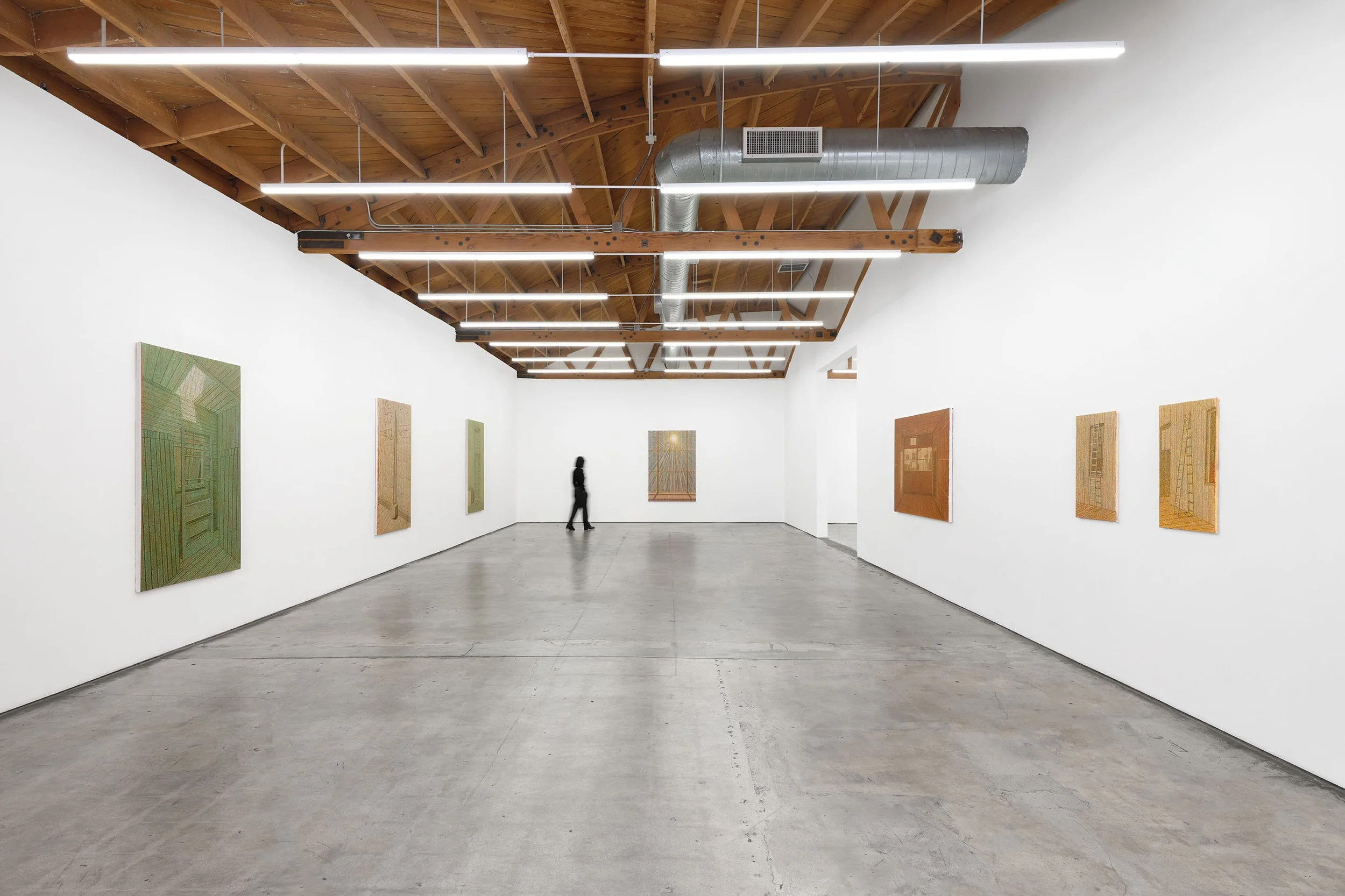
Installation view: Marco Bizzarri, Cielo abierto, Megan Mulrooney Gallery, 2025. Photo courtesy of Megan Mulrooney Gallery.
Your work has been described as employing techniques such as sandblasting to cover and reveal surfaces, almost as a way of ‘erasing’ and ‘revealing’. What draws you to this idea of concealment and revelation in painting?
“The way I paint emerges directly from my experiences and concerns within the landscapes I record. In the Atacama Desert, the environment is extremely dry and windy, and dust is constantly suspended in the air. This dust not only veils the landscape visually but is also a real and problematic presence, often toxic due to nearby mining activity. This condition affects both perception and the daily lives of those who inhabit these territories.
In response, I became interested in dust both as material and as concept. In painting, I began to splatter and layer surfaces to create atmospheres of minute particles that obscure the initial image, echoing that visual experience of the landscape.
In this context, dust acts simultaneously as residue and archive: it covers surfaces, softens visible information and, at the same time, preserves and sustains what has been abandoned. It does not erase completely, but rather suspends the image in an intermediate state between presence and disappearance.
At first, my attention was focused on dust in the exterior environment, but over time I began to notice the suspended dust revealed within the shadowed interiors of houses. This shift in gaze emerges from a personal enquiry into death and loss, through which I began to understand dust as a metaphor for persistence. As a trace of what is no longer there, dust requires light in order to become visible, reminding us that absence does not equate to disappearance, but rather to a suspended, silent presence in the air. In this way, dust embodies a latent presence: a material memory that inhabits space from the invisible.”
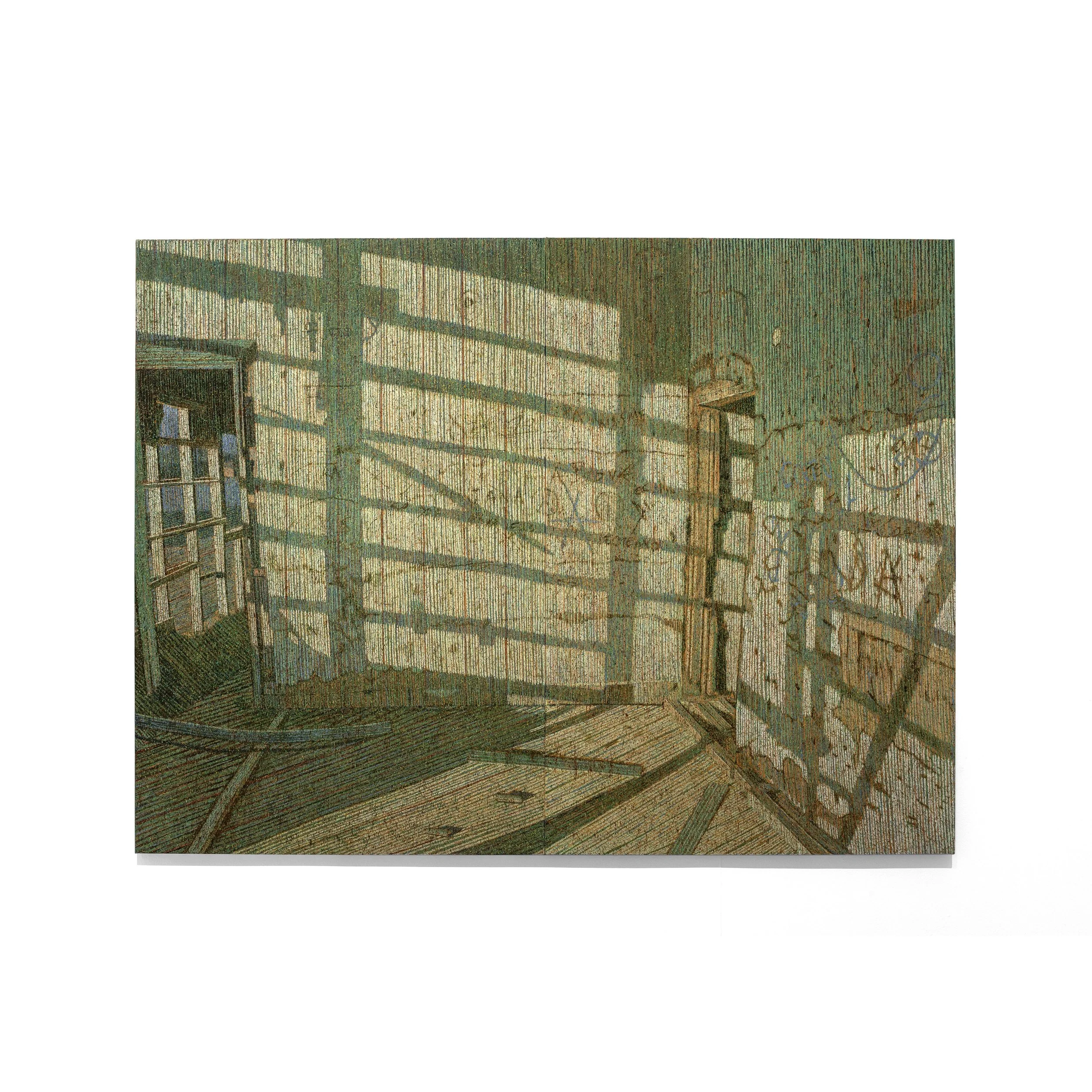
Marco Bizzarri, Trapiche Oil and acrylic on canvas, 180 x 40 cm, 2024.
You frequently explore memory, the passage of time, and the tension between decay and resistance, particularly through rural landscapes and abandoned spaces. What draws you to these themes?
”I believe painting is the most effective medium to talk about absence, what is not physically present within the image. These places allow me to investigate the persistence of absence: how traces of past lives and human experiences remain embedded in the spaces they once occupied. I am interested in the passage of time, in all the accumulated information contained within a wall, a door or a window. At the same time, this poses a challenge for painting: how to translate those images, that experience and that light onto a canvas. I feel that painting also functions as a means of rescuing that archive and memory into something tangible.
I have always been drawn to spaces that contain you, not only physically, but emotionally and spiritually. Their scale, silence and the way light moves within them generate a sense of stillness, introspection and calm. I actively seek out these moments of solitude, and this tendency intensified some years ago as a result of a personal period of mourning. This led me to wander aimlessly through abandoned houses in northern Chile.
I began to pay close attention to the ways in which light entered these spaces unexpectedly, through collapsed roofs and crumbling walls, the wounds of time. I became interested in these unforeseen and suggestive forms, in the spontaneous and random behaviour of light in all its variations. At the same time, there was an adrenaline charge: these places are not without danger. I often find myself so absorbed by the light, attempting to capture the perfect frame with my camera, that I momentarily lose awareness of the risks involved.
To be inside these spaces is to enter a realm suspended in time, where everyday temporality dissolves. Their scale and silence generate a feeling of smallness and vulnerability in relation to what endures, while simultaneously prompting an awareness of the persistence of the past. This experience encourages a slowing down, a contemplative rhythm akin to meditation, where perception intensifies and every detail, the filtered light, eroded surfaces, dust suspended in the air, acquires significance.
Immersion in these environments allows for an intimate relationship with absence. Observation becomes an act of presence, connecting with the memory of the place, its history and the lives that once inhabited it. Time feels suspended, allowing for hours of contemplation without the need for action, simply looking, thinking and breathing, and then, from this experience, attempting to translate the atmosphere and memory of the space into painting.”
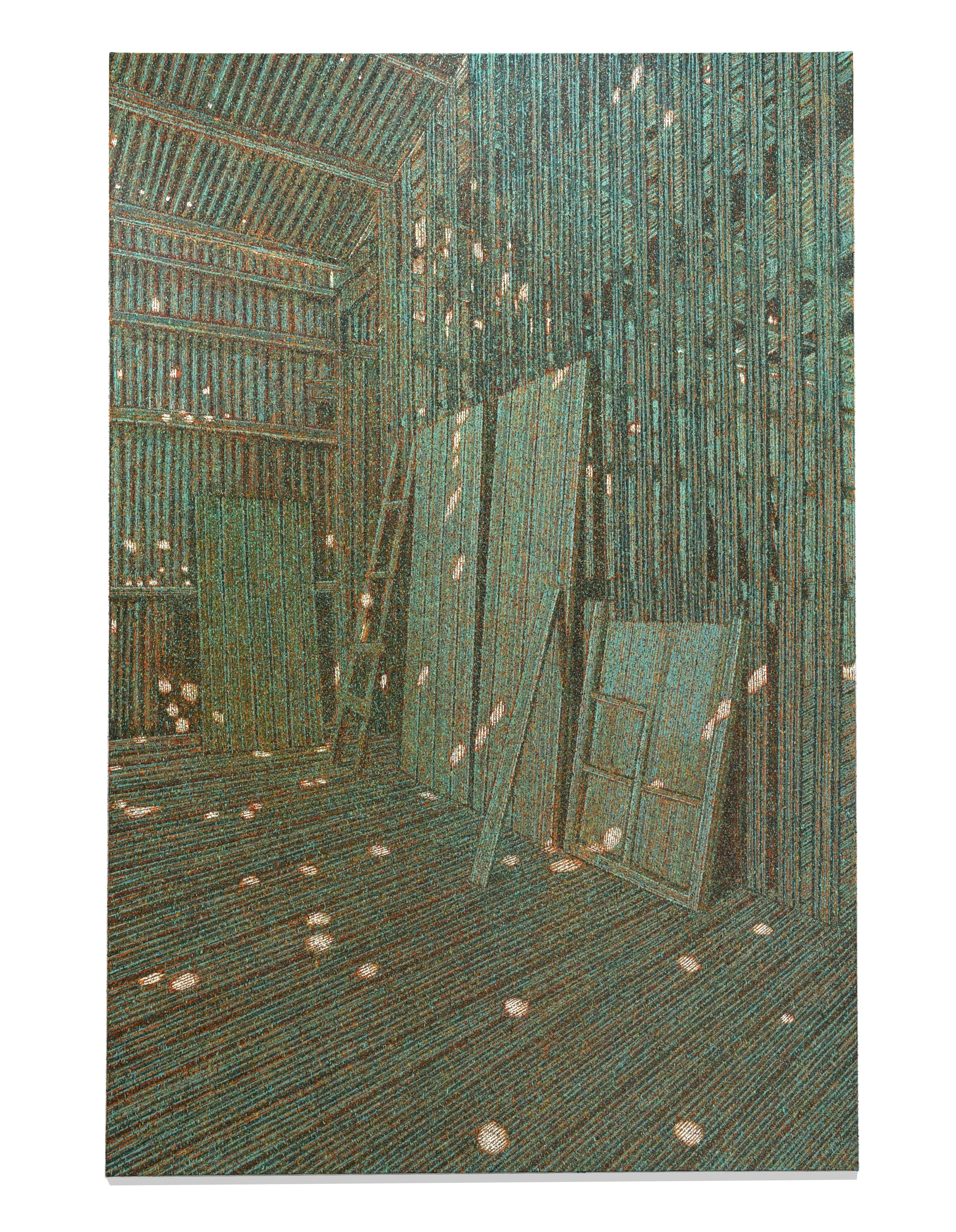
Marco Bizzarri, Camara de estrellas, Acrylic and oil on canvas, 120 x 180 cm, 2025.
Do you believe landscapes contain history, trauma and memory even when human presence is absent? And can painting access that persistent presence?
“In the Atacama Desert, dust functions as an archive of time, preserving material and symbolic remnants of what has existed. Suspended in the air or settled on surfaces, it does not erase history but holds it in latency. Painting accesses this persistent presence through matter, light and temporality. Just as dust only becomes visible when light passes through it, painting allows us to reveal what remains invisible in space, what photography cannot capture and what lends itself to multiple interpretations.
The spaces I choose for my paintings are not neutral. They are territories that have been inhabited and that still retain memory, history and material traces of time and human experience. Light, understood as both a perceptual and spiritual experience, activates these traces, rendering visible what persists in silence. Painting thus becomes an exercise in attention and contemplation: a means of translating atmosphere and memory, and of giving material form to the intangible.”



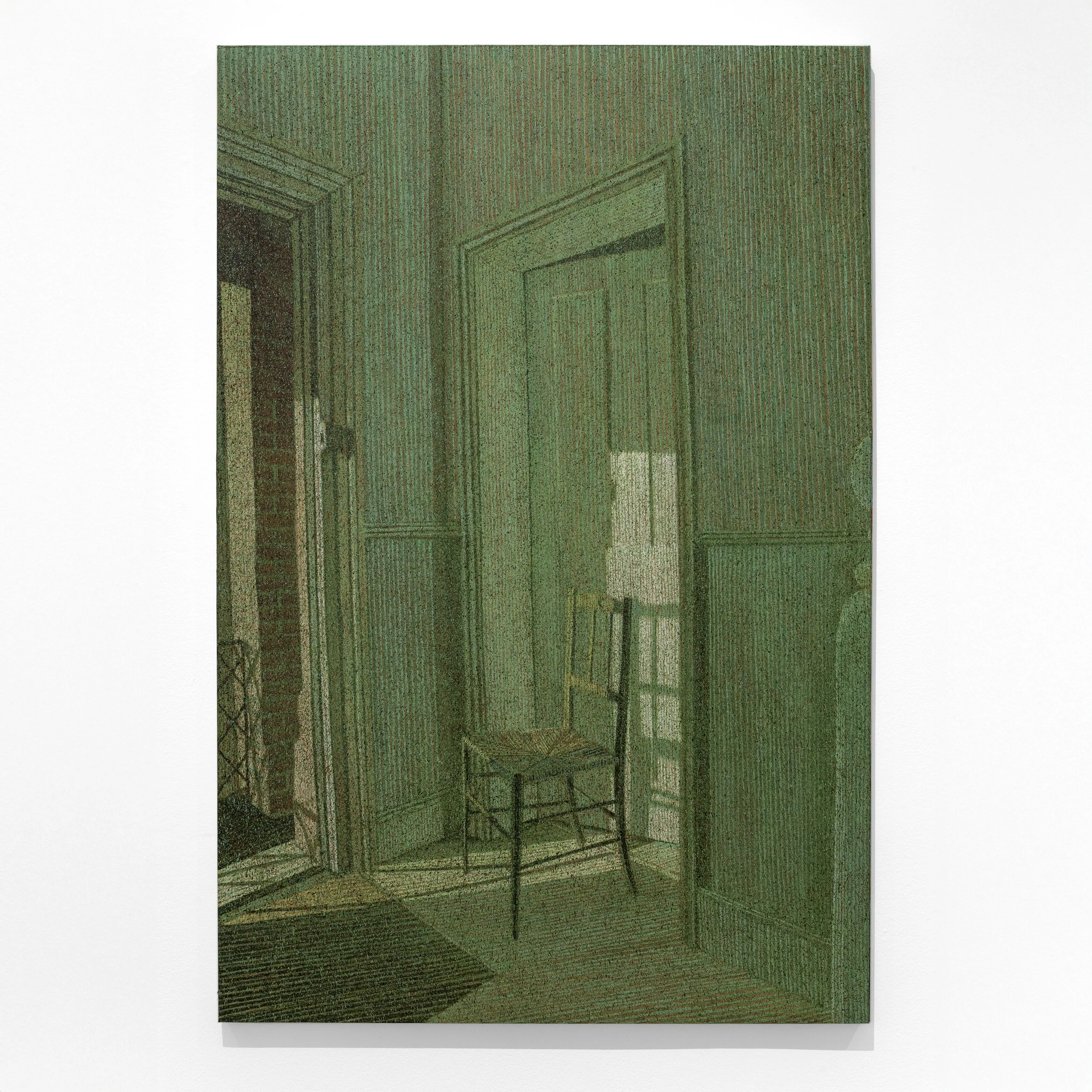
Marco Bizzarri, Apertura I, Oil and acrylic on canvas 120 x 180 cm, 2024.
You speak of ‘translating images’, from photographs or memories into painting. What does ‘translation’ mean to you?
“For me, translating images does not mean copying them, but transforming and re-signifying them. Photographs and memories function as points of departure, records of experience in the Atacama Desert, but not as ends in themselves. Pictorial translation involves transferring atmosphere, light, suspended dust and a sense of stillness into painting, creating a language of its own that transcends straightforward representation.
In this process, the image loses precision and becomes fragmented, and it is precisely within this ambiguity that I find its value. Painting does not literally reproduce reality; instead, it captures the memory of a place, its persistence and the traces of time. Translation is therefore an act of transformation: transferring the intangible, history, memory, the latent presence of absence, onto the painted surface, allowing the work to construct its own narrative and its own memory.”
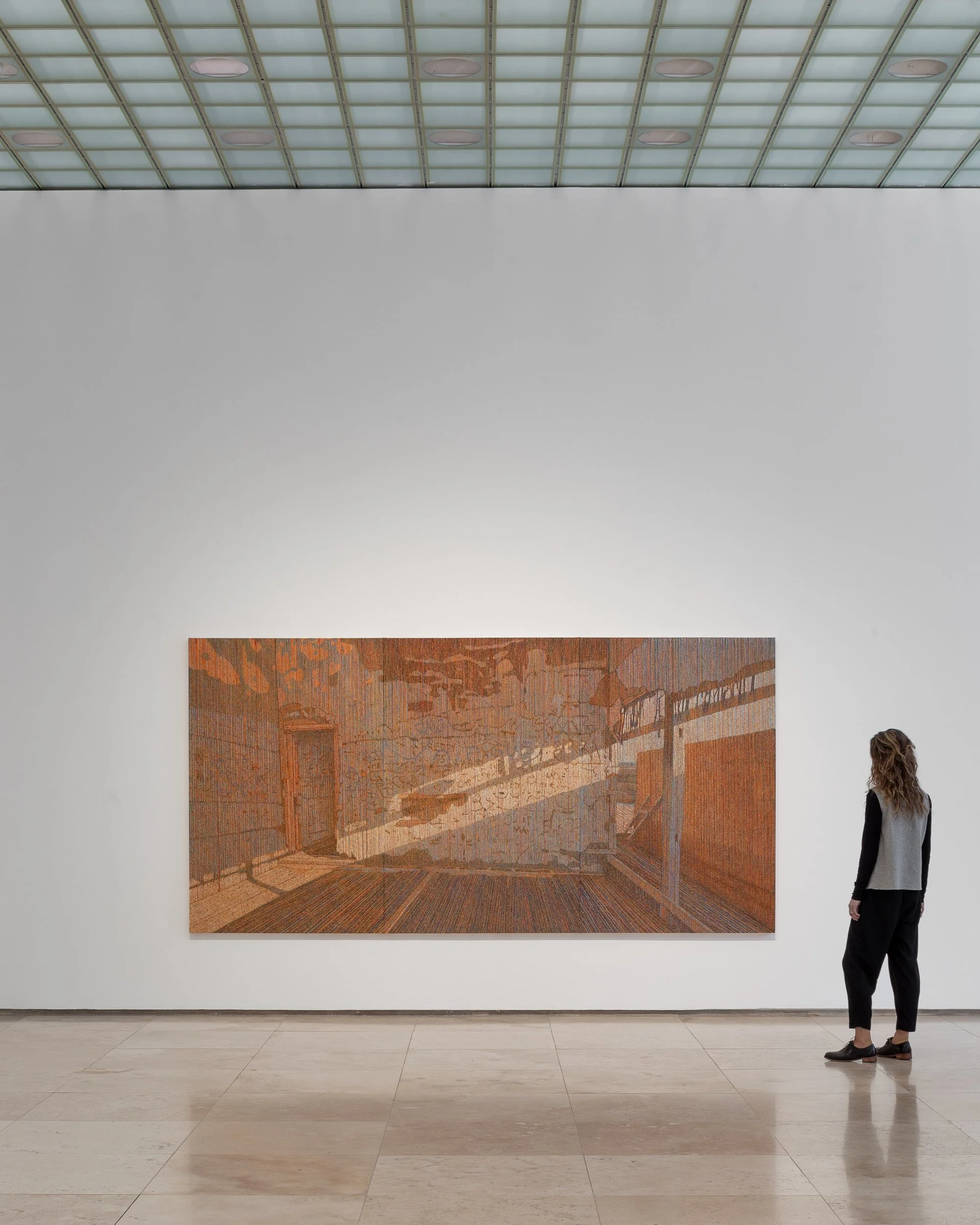
Installation view: Marco Bizzarri, Distancia Visible, Patricia Ready Gallery, 2024. Photo by Felipe Ugalde. Courtesy of Patricia Ready Gallery.
Recommended