dialogue
Florine Imo | Artist
February 2026
8 min read
Florine Imo’s practice began with resistance. Early labels of “girly painting” revealed how femininity is often dismissed as decorative or unserious, prompting her to enter that language deliberately, exaggerating, dissecting, and reclaiming it as something complex and charged.
Imo’s figures exist in contradiction: soft and sharp, divine and painfully human. Drawing from history, religion, and mythology, she revisits goddesses, angels, sirens, and martyrs to expose how female power has been feared, idealised, and disciplined, then collapses these archetypes into the present through personal experience and everyday intimacy.
Across painting, drawing, and sculpture, vulnerability becomes a form of strength. Fragility is not weakness but a site of visibility, where myth meets lived reality. Her work holds this tension open, building a visual universe shaped by desire, belief, fear, and the persistent need to be seen.
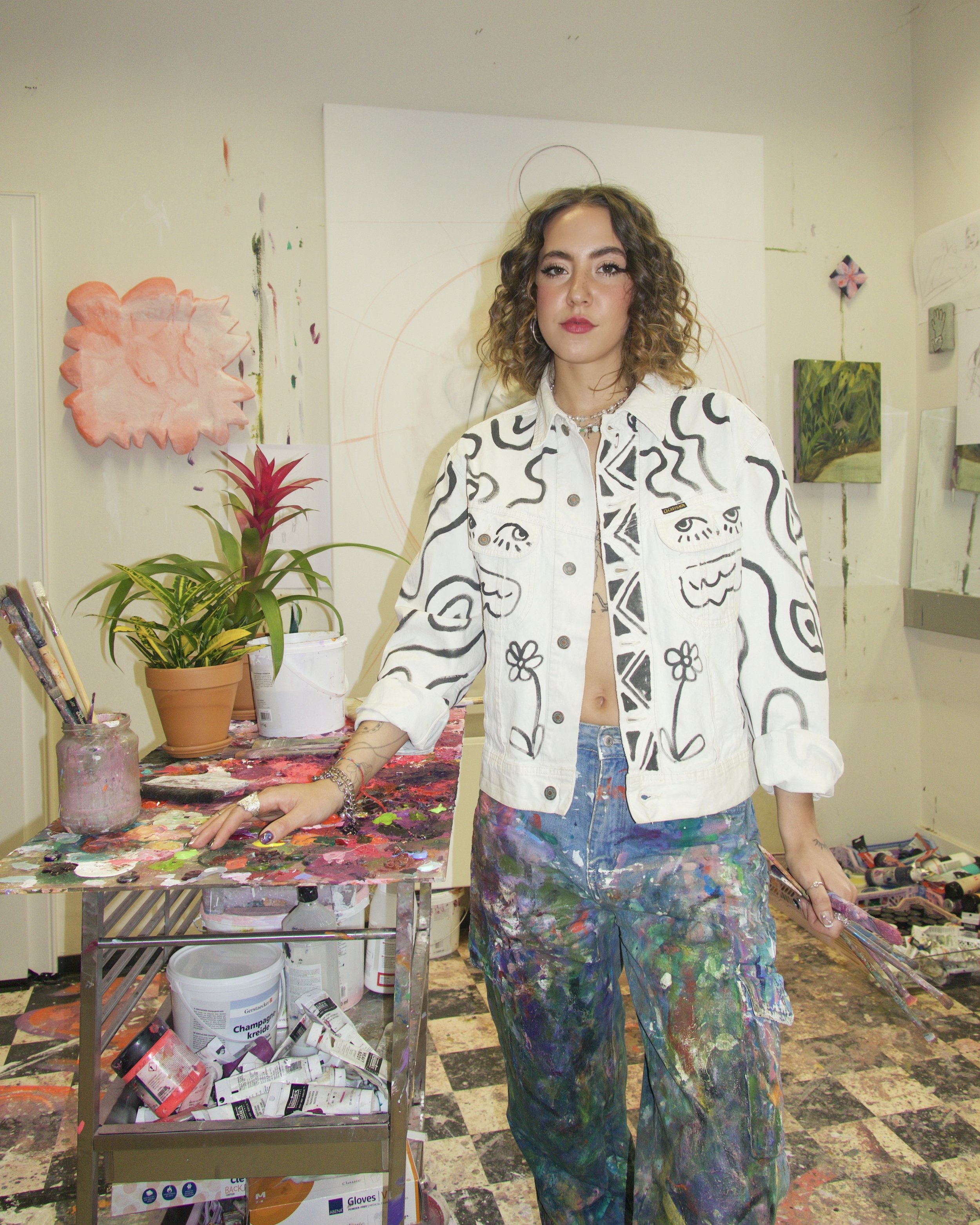
Florine Imo. Photo by Elias Zazjal.
Your work re-imagines femininity through figures that merge strength, vulnerability, myth, and everyday intimacy. How did you arrive here with your practice?
”My practice began with resistance. Early on, my work was described as “girly painting”, a term that initially sounded casual, almost harmless, but revealed a deeper tendency to reduce femininity to something decorative, sweet, or unserious. The more I sat with it, the clearer it became that this label carried a long history of dismissal. Instead of rejecting it, I chose to enter it deliberately and take control of it.
I began working in series as a way to investigate what “girly” actually means, exaggerating it, dissecting it, and reclaiming it as a visual language with weight. From there, my figures evolved into women who exist between opposites. They are soft and sharp, seductive and threatening, divine and painfully human. I became interested in femininity not as an identity, but as a condition shaped by contradiction.
As my practice developed, I turned to history, religion, and mythology to look for earlier metaphors of the same female spirit we are still negotiating today. Goddesses, angels, sirens, martyrs, figures that were once feared, worshipped, and powerful, before being moralized, idealized, or punished. Reinterpreting these archetypes in a contemporary context allows me to collapse past and present, exposing how persistent these structures of projection and control still are.
Pop culture, personal experience, and everyday intimacy ground these mythological references in lived reality. Vulnerability became unavoidable in my work. I’m drawn to women who bleed, doubt, desire, and protect themselves without losing power. For me, fragility is not the opposite of strength, it’s where strength becomes visible. The tension between myth and intimacy, fantasy and reality, is where my work lives.”
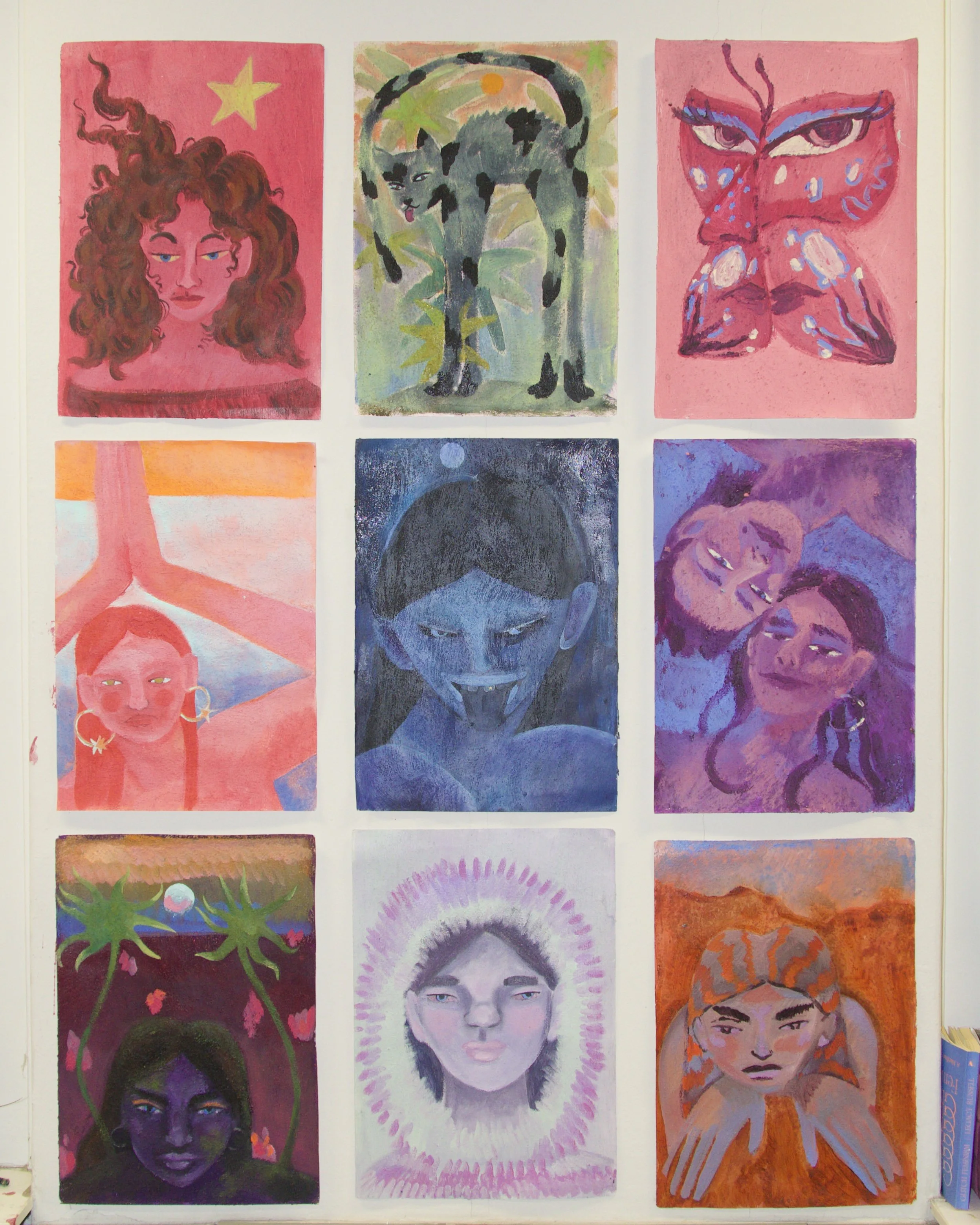
Florine Imo, Acryl and sand on paper, A3, 2025/26.
You’ve worked across drawing, painting, and sculpture. How does moving between forms influence the ideas you pursue?
“Moving between sketching, drawing, painting, and sculpture allows my work to move beyond the image and enter physical space. Each medium serves a distinct function. Sketching is where I think and test, it’s analytical and structural. Drawing, often on paper with acrylics, is where I free myself from expectation, making small works that exist without judgment.
Painting is where I build symbolic worlds and narrative, while sculpture is where those worlds step into reality. I’m deeply invested in the thinking process of finding formal solutions to an idea. I don’t approach media hierarchically, any material can become part of the work if it helps achieve a specific form, gesture, or atmosphere. Materials like papier-mâché, found objects, or mixed media allow transformation, especially when I’m trying to materialize something fragile or immaterial, such as smoke, breath, or emotional residue.
What I value most about sculpture is its ability to shift the relationship between the viewer and the work. Scale becomes essential. Life-sized or monumental forms stop functioning as images and begin to function as presences.
In this sense, I think of my sculptures as painterly constructions in three-dimensional space. They function as the fantasy of a painting made real, carrying gesture, atmosphere, and emotion beyond the frame. Through material, scale, and process, the work gains a kind of soul through its physical and emotional presence.
At the same time, my relationship to different media is deeply emotional and physical. Working across forms feels like being in love with many things at once. I love painting for painting itself, the moment where my mind quiets and the act becomes almost instinctive. I love finding ideas for paintings, it feels like making movies in my head. Making large scale sculptures is the opposite, it’s chaotic, exhausting, and confrontational, like fighting for survival inside the work, negotiating gravity, material, and scale. In contrast, working with clay is slow, delicate, and nurturing, a process that demands care and attentiveness. Working with clay also makes you remember that everything is mortal, nothing lasts forever, everything breaks at some point, and that’s okay. Each medium asks something different of my body and mind, and moving between them keeps my practice alive, responsive, and honest.”
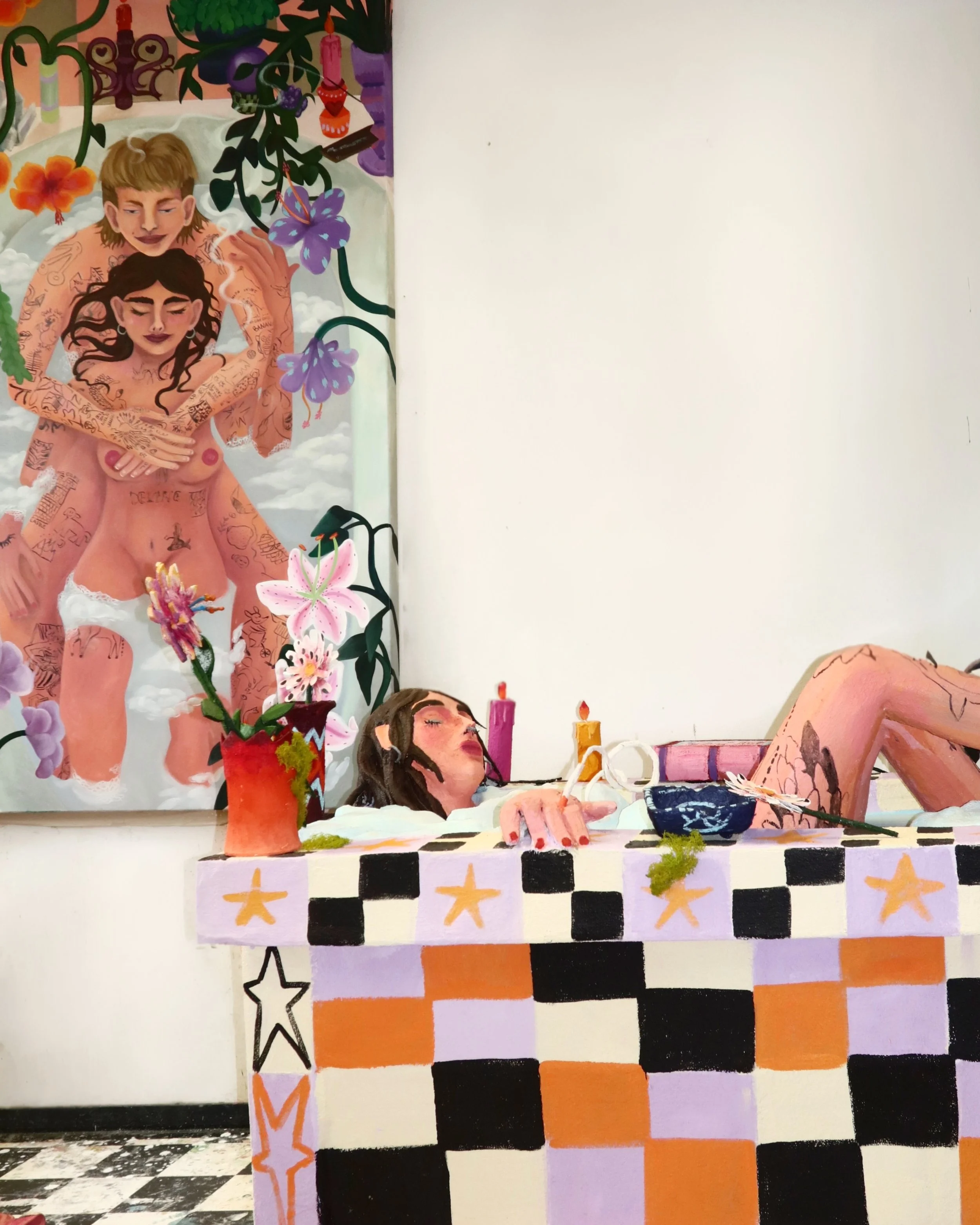
Florine Imo, studio shot. Photo courtesy of the artist.
Has your understanding of what your work is communicating shifted over time, or does it feel like a continuous thread?
”I experience my practice less as a series of shifts and more as a continuous thread that has been expanding over time. There was never a harsh break in my interests. The universe I’m working within began very early, the moment I started drawing. Some of my earliest childhood drawings were already of pretty girls and flowers, which feels almost ironic in hindsight, but also very telling.
What has changed is not the core imagery or impulse, but my understanding of it. As I grew older, the intuitive gestures of those early drawings became conscious inquiries. Through theory, lived experience, and research, I began to understand how these images are historically, socially, and politically charged. What once felt instinctive slowly revealed its depth, complexity, and urgency.
My work is often framed primarily through a feminist lens, which I understand and value, but I don’t experience it as limited to that category. At its core, my practice is about shared emotional experience, longing, belief, desire, fear, and the human yearning for something beyond the visible or the rational. It’s about world building and storytelling, constructing a visual universe that functions like a collection of myths.
This universe is told through my voice, a woman’s voice, which still carries the responsibility of being clearer, louder, and more explicit. That feminist dimension is inseparable from my position, but the work itself reaches further, toward connection, recognition, and the need to see ourselves reflected in stories that make sense of the world.”
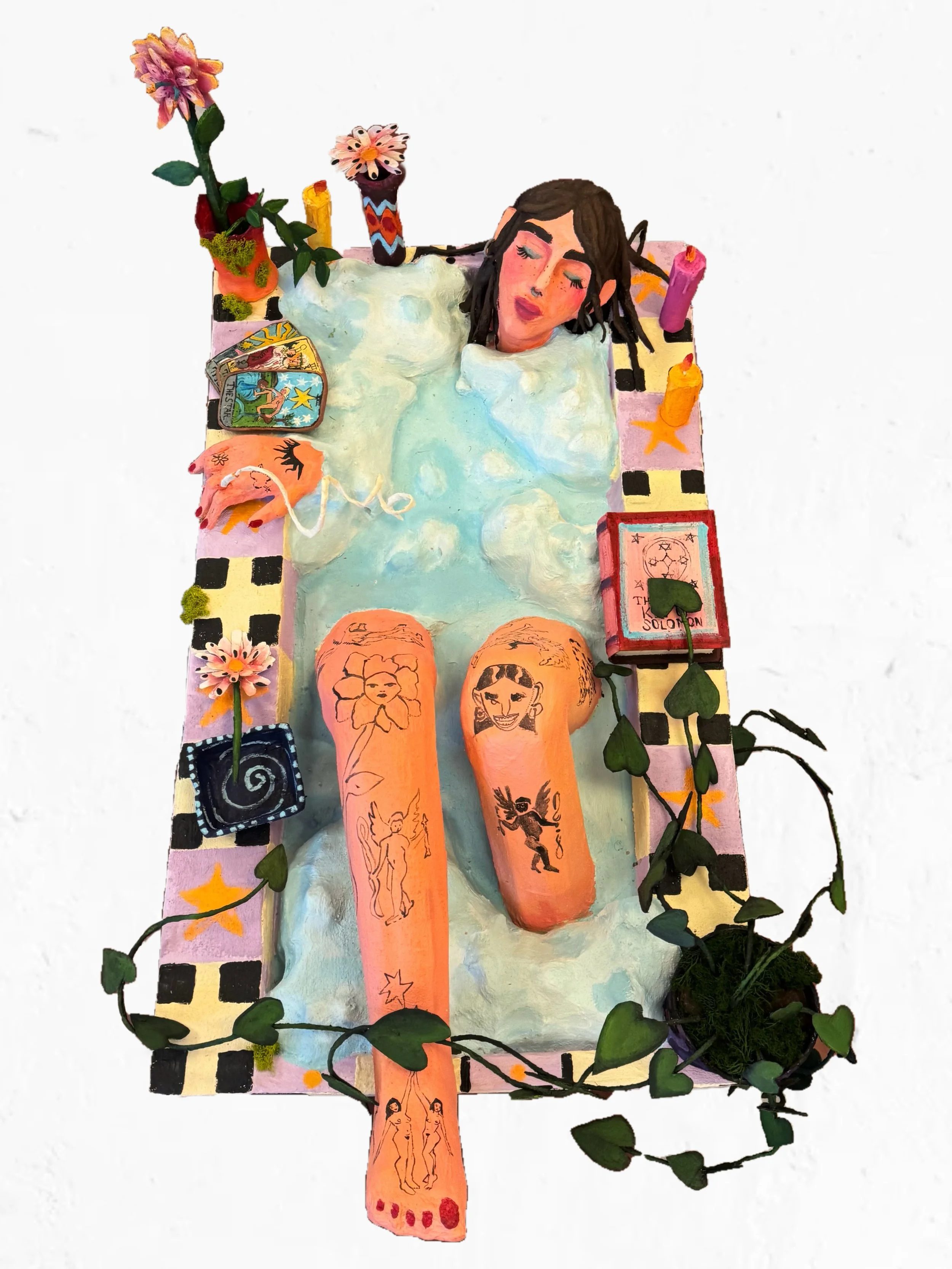
Florine Imo, Sharp water, Soft burn, 175 x 115 x 100 cm, 2025.
You’ve spoken in the past about wanting to push certain ideas further. What feels like the next point of curiosity in your practice?
“I’m interested in expanding the universe I’m already building through sustained world building. Rather than producing isolated works, I’m thinking in terms of environments, chapters, and evolving mythologies, where painting, sculpture, sound, and narrative operate as one system.
At the center of my current research is a new series focused on the history of witch hunts and superstition as a mechanism of misogynistic control. I’m examining how fear, belief, and moral panic were projected onto women’s bodies, knowledge, sexuality, and forms of care. Superstition wasn’t irrational, it was a socially sanctioned language of punishment, a way for violence to gain legitimacy through belief. What interests me is how these structures are tied to a deeper human yearning for meaning and transcendence, a longing that is repeatedly redirected onto women and their bodies.
Within this research, the flower has emerged as a central symbol. Historically associated with healing, poison, witchcraft, beauty, and suspicion, it becomes a metaphor for feminized knowledge, something ornamental and seemingly harmless that turns threatening once it carries agency or power. This logic mirrors both the historical treatment of witches and the contemporary dismissal of “girly painting”, aesthetics that are tolerated as long as they remain decorative.
Materially, my focus is moving toward sculpture and larger, almost architectural forms. Papier-mâché entered my practice this year, and working on my last piece sharp water, soft burn made me realize how much this material can hold; fragility, effort, and change at the same time. I’m drawn to making structures you can physically relate to, where scale affects the body and the work feels almost inhabitable.
While my practice continues to expand into sound and other intimate material languages, this expansion isn’t about doing everything at once. It’s about precision. I don’t believe an artist is defined by a medium, but by the clarity with which an idea finds its form. The goal is not to produce more, but to allow each idea to exist fully and speak with weight. This phase of my work is grounded in trusting experimentation and intuition, and listening closely to what each idea asks for. As an old saying goes, nothing answers to force, only to attention.“



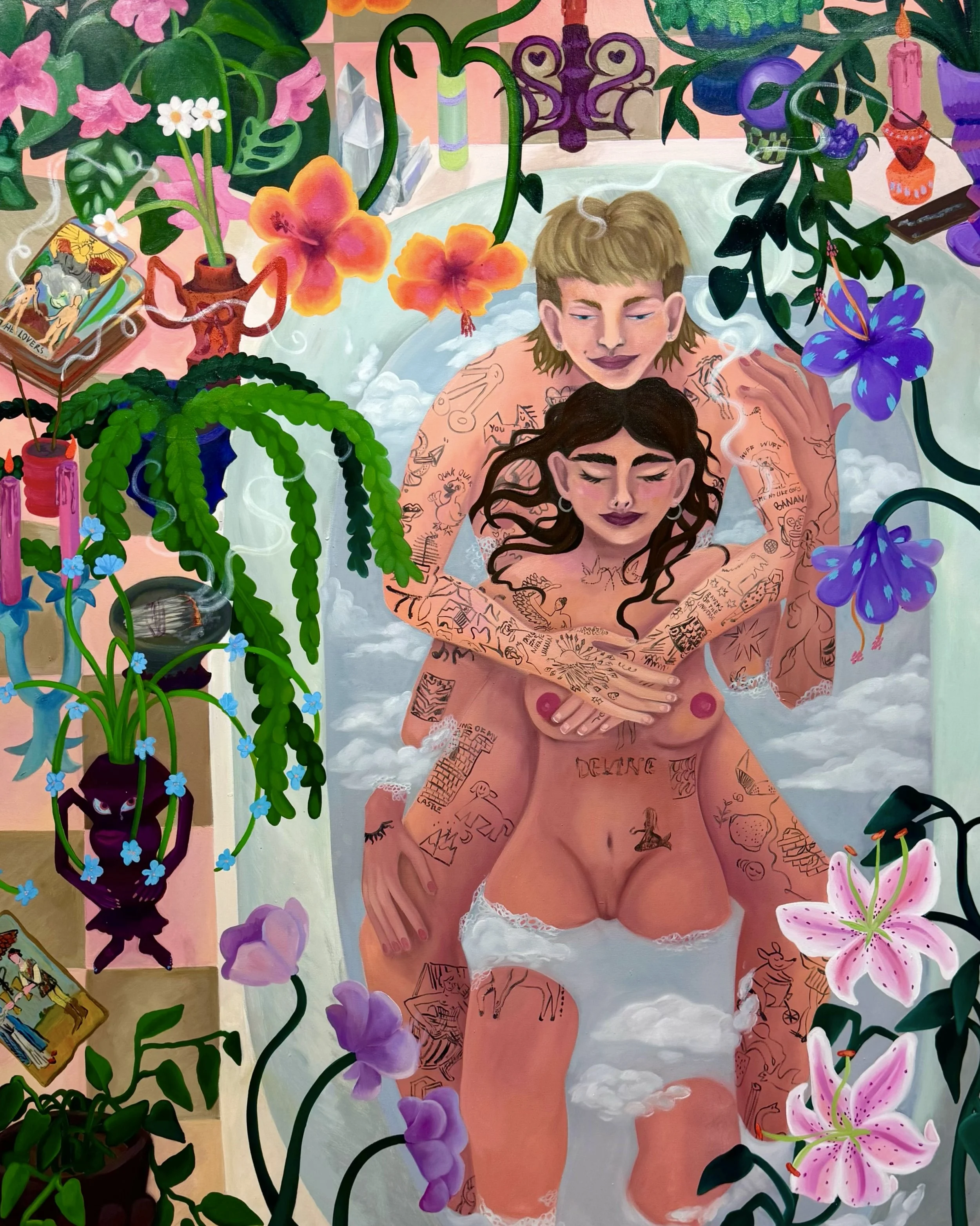
Florine Imo, Underneath the armor, Acryl and oil on canvas , 180 x 150, 2025.
Looking back at your exhibitions so far, what moments of growth stand out to you?
“Looking back, the moments of growth that stand out to me are both external and deeply internal. Over the past four years, I’ve had the privilege of showing my work internationally and living in places like London, Los Angeles, and Mexico, experiences my younger self could never have imagined. I carry a lot of gratitude for those opportunities and for exhibitions I’m still deeply proud of.
At the same time, growth has come through difficulty. Like many young artists, I encountered moments of exploitation, confusion, and disillusionment early on. Those experiences taught me how to recognize the value of my work and, more importantly, how to say no. That shift marked a transition from simply participating in the art world to actively authoring my own path within it.
Community has been essential to that growth. Sharing studios, daily life, and vulnerability with other artists who understand the emotional and economic instability of this profession changes everything. This job requires a certain madness, the inconsistency, the uncertainty, the art market, and still showing up with commitment and care anyway. You have to be a little crazy and relentlessly consistent at the same time.
The most meaningful growth has been learning to return, again and again, to the work itself. Producing show after show can pull focus away, but the work is the source. Protecting that relationship, and continuing to make work with gratitude and clarity, feels like the greatest achievement so far.“
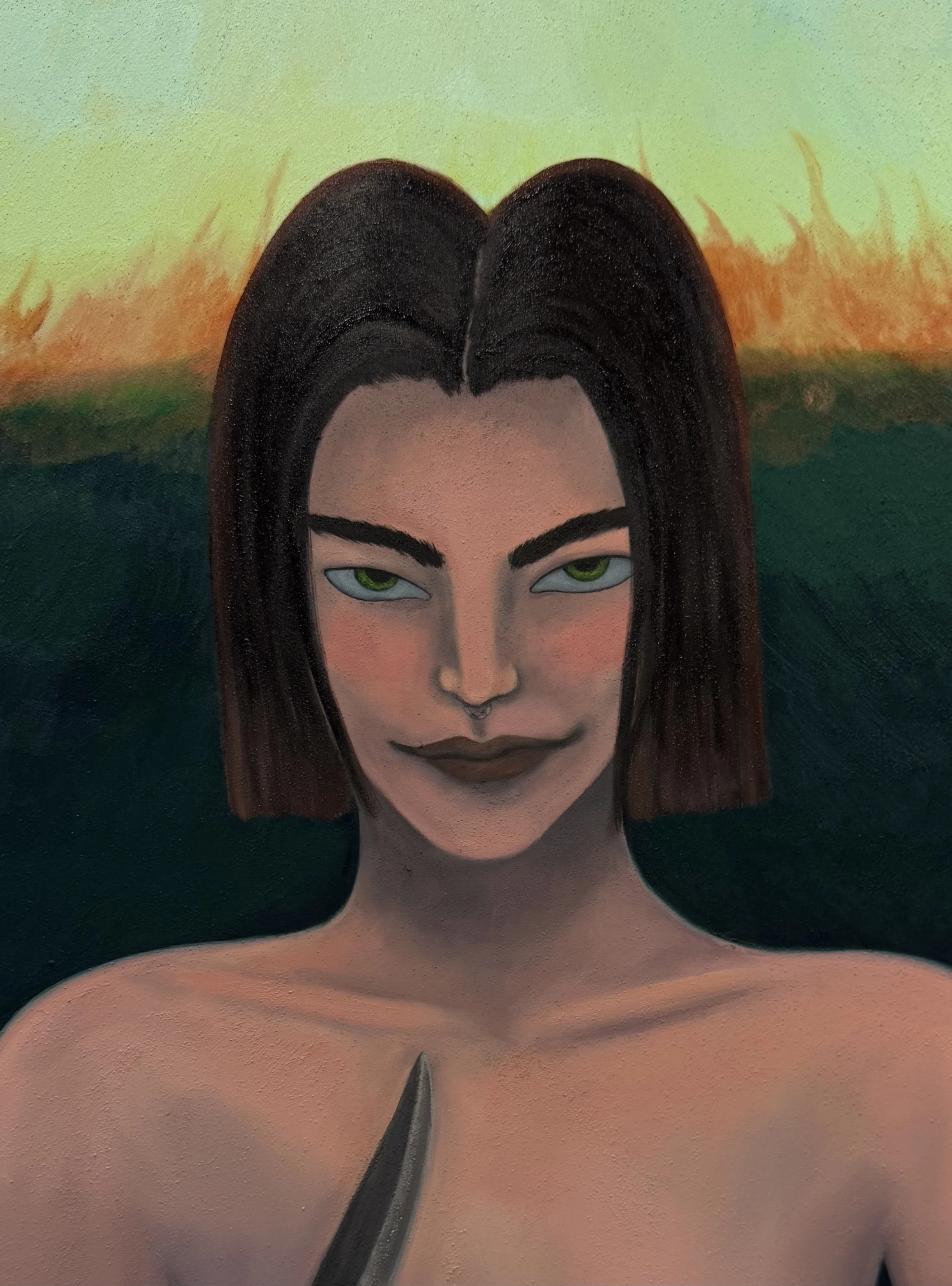
Florine Imo, She ate, Acryl and oil and sand on canvas, 120 x 80, 2025.
Recommended